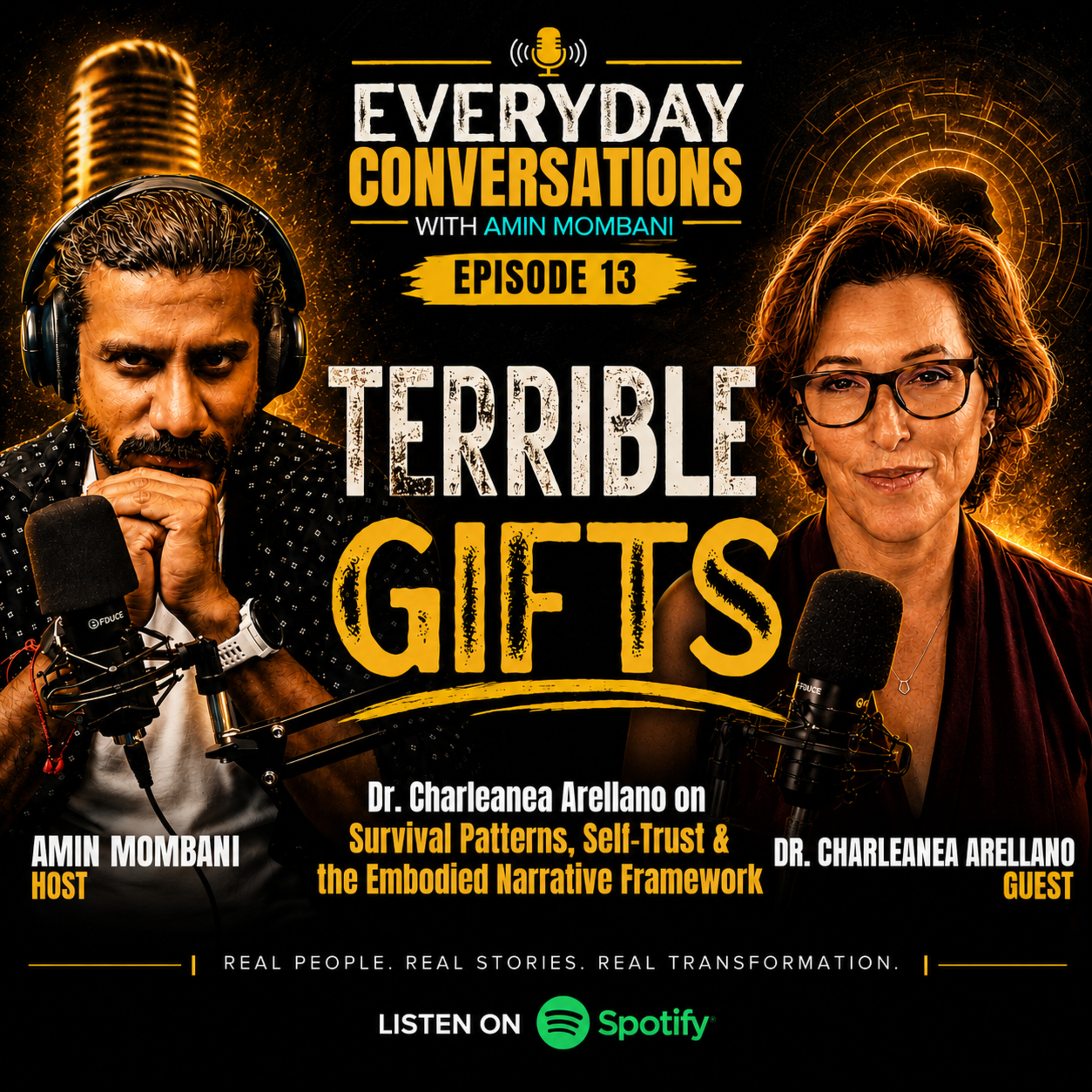
EPISODE 13 | TERRIBLE GIFTS — Dr. Charleanea Arellano on Survival Patterns, Self-Trust & the Embodied Narrative Framework
Statistically, she shouldn't be sitting in this conversation. A childhood of poverty, neglect, and abuse in Denver could have written her story for her. Instead, Dr. Charleanea Arellano became a psychologist and leadership coach of over 30 years, spent her adult life turning her hardest experiences into what she calls "terrible gifts," and built a framework — Embodied Narrative — that's now reshaping how her clients understand themselves.
In this episode, Amin talks with Dr. Charleanea about reading a room to survive before she had language for it, proving her own capability through softball, bodybuilding, and triathlons, coming out fully as a queer Latina woman in 2024, and the brutal year that followed — 2025 — when everything that used to work for her simply stopped. What came out of that year became the foundation of the work she does today.
🎙️ In this episode:
- Growing up without adults around, and learning to read a room to survive
- Why she says "you aren't what happens to you — it cultivates who you become"
- From competitive softball to bodybuilding to triathlons: proving her own capability
- Why she wrote the memoir Terrible Gifts alongside her clinical work
- Coming out fully as a queer Latina woman in 2024— her best year
- 2025: investing everything into her business and getting nothing back
- Why insight alone doesn't change a pattern — and what does
- The Embodied Narrative framework, broken down in plain language
- The pattern she sees most in high-achieving women leaders that nobody says out loud
- Wildcard: hilariously bad at strategy games despite being excellent at life strategy
💬 "You aren't what happens to you. The things that happen to you cultivate the person you can be." — Dr. Charleanea Arellano
🎧 Watch the full conversation on YouTube: https://www.youtube.com/channel/UCIoXPESGBAlhpbeWg_E7Hrw
-------------------------------------------------Contact Details for Guest Dr. Charleanea Arellano — Psychologist, Leadership Coach & Author of Terrible Gifts Website: https://drcharleanea.comFacebook: https://www.facebook.com/CharleaneaMArellanoPhD/ Instagram: https://www.instagram.com/drcharleanea/LinkedIn: https://www.linkedin.com/in/drcharleaneaarellano/TikTok: https://www.tiktok.com/@drcharleanea?lang=en-------------------------------------------------Contact Details for Host Amin Mombani - Host Email: [email protected] Website: https://aminmombani.podview.com Youtube Link: https://www.youtube.com/channel/UCIoXPESGBAlhpbeWg_E7Hrw Spotify Link: https://open.spotify.com/show/033CGyVtUGh2KFJ0MJypEZ Apple Podcast: https://podcasts.apple.com/us/podcast/everyday-conversations-with-amin-mombani/id6782858287 CastBox: https://castbox.fm/channel/id7284639?country=us LinkedIn: https://www.linkedin.com/in/amin-mombani-29979721/Facebook: https://www.facebook.com/profile.php?id=61592072735008#EverydayConversations #TerribleGifts #EmbodiedNarrative #SelfTrust #TraumaToTransformation
I realized that the thing that I was hiding, the thing that I was running from, the things that I was ashamed of, actually made me the person I am today and the person with whom I'm most proud. So why be ashamed of those things?
Welcome back to another episode of EVERYDAY CONVERSATIONS, and I'm your host, Amin Mambani. If you haven't subscribed yet, go do that. New episodes every week. Today's guest has spent more than 30 years answering one question. How do we become more than what has happened to us? She's a psychologist, leadership coach and author who has lived the exact journey she now helps others navigate. And she named her memoir Terrible Gifts for a reason. Please welcome, Doctor Shalini. Dr. Shalini, welcome to a bit of conversations.
Thank you. Thank you, Amin.
How are you? How are you doing today? I am doing very well, thank you. I'm enjoying the beautiful weather in Denver, Co. It's it's summers we look forward to because we can be outside and doing lots of activities outside. How is your day today? What is your plan for the day? Oh boy, I've got a busy day. I've already been on the I've been on a few phone calls. I get up early in the morning, by the way. I mean, I wake up every morning at 4:30 and from about 4:30 to about 8:00. AMI do my writing during that time.
That is my creative time. So I do that and then I typically have clients or business meetings. So I've already gotten, I mean, it's now it's 9:00 here. So I'm already 5 hours into my. Day that's the best time to wake up. I also wake up usually at 4430 and then start David meditation prayers and then go for a run, gym, whatsoever and then by the time five hours gone I'm in the office and then starts my words and everything comes up. Yep, Yeah, it's a great time to start your day, isn't it? There's something about the the energy and the air.
It just seems really clear and quiet and still. I like that. Definitely tell you something about you. Who is Doctor Shalini? Oh, so my professional. So as you'd mentioned, I'm a psychologist. I've been practicing for over 30 years. I've been around a few blocks there. I mean, and you know, my, I would if, if somewhere someone were to ask me like what is your specialty? What do you, what do you, what do you do? I would probably tell them that I help people basically, you know, not just navigate, but to pivot, you know, and to actually use the hard things in their lives as something that propels them forward.
I think, I think one of the the biggest misunderstandings that humans have is that if you've had horrible things happen in your life, like let's just say you didn't get a good hand, you didn't get dealt a good hand. People believe that that defines who they are. It defines their future. It defines their choices. And I disagree. I absolutely disagree. And I'm a living example of that. Like if you were to, if you were to look at my story, if you were to look at my background, if you'd look at my childhood, you know, statistically speaking, I wouldn't be sitting here in front of you today doing a podcast interview.
I mean, and, and I'm a living example of you aren't what happens to you. As a matter of fact, the things that happen to you cultivate or create the person that you can be. It creates your gifts, it creates your strengths, it creates your zone of genius. So I look at adversity in a very different way.
You have said you have learned to read a room and make yourself small or strong enough to survive before you had language for any of it. What did a normal day actually look like for you as a kid? Oh. My goodness, it was, it was quite crazy. I mean, so I'll give you, I'll give you different examples, OK, How's that good? I grew up, I grew up in the city of Denver. And when I say the city of Denver, I say the city proper. And you know, Denver back then wasn't a a huge city, but it was still a city nonetheless, right?
You had the typical things that you see in a city. You have crime, you have poverty, you have, you know, you have people on the street, you know, when you're looking at a downtown area where you have, you know, drug abuse, you have prostitution, you have all these things. And the reason I share this with you is because the way that I grew up is I really didn't have adults around. There was no one taking care of us. So there was myself and my my 2 younger brothers. So I was the oldest and I felt responsible for them and for myself, not only in terms of protecting us, but for taking care of ourselves.
And so very young. And when I say very young, as early as I can remember, I mean, I can remember being very conscious what's going on around me? Are we safe? What do I need to do? You know, really paying attention to those kinds of things. And so that's what was going outside, going on outside of my home, inside of my home wasn't much better. So, you know, I grew up with poverty. You know, I was raised primarily by my grandmother and my grandmother was very poor and, you know, she worked a lot. And so we were left alone.
We were left alone. Now, what's interesting is there was kind of a, a contrast because I would spend a lot of time with my grandmother and then I would go home to my parents home. And my father was, you know, he did the best he could, he know with what he had, but he was a very angry, violent man and very abusive. And so I grew up with a lot of abuse, a lot of physical abuse, a lot of emotional abuse. And so if you were to boil it down, I mean, I mean, basically, I grew up in circumstances where I wasn't sure if I would have food.
I wasn't sure if I was going to be protected. There was nobody there to take care of me. And so I learned a lot of skills from that. You know, when you were talking about my learning to read a room, well, that's a gift that I have. I will tell you that one of my zones of geniuses is being very sensitive and very aware of people around me. Their energy, their mood. You know what they bring into a room? Well, where did that come from? That came from my childhood because I had to be very vigilant. I had to be very aware because my safety depended on what was going on around me.
Impressive, amazing reply for that. You spend years proving your capabilities physically, mentally, emotionally, because childhood had limited you so much. What was the first thing you remember pushing yourself to prove? Oh, my goodness. That's a great question. I mean, so, you know, I did grow up. I grew up in a household. How would I describe this? There just wasn't a lot of opportunity. My parents were very young. They were very young and they were very, you know, they were, they were caught up in their own stuff.
And so there wasn't a lot of investment or encouragement. So we had the basics. I went to school, that was about it. And so interestingly, I left home early and I left even before I graduated high school. I left when I would just just barely turn 17. And my first thing that I did, because, you know, for me, I mean, school was very easy. That was not a challenge for me. That wasn't something that stretched me. And you know, when I was growing up, I didn't, I didn't play sports, I didn't do any extracurricular activities.
So the very first thing I did when I, when I got out of, when I moved out of my, my father's home was I picked up my first softball at 17. I picked up AI, picked up my first softball. I've never played any sports. And so the first thing was softball. And because of the person that I am, I mean, I don't do anything half heartedly. I have to be good at everything. So that became my new obsession and my new challenge. Not only did I play softball, but I had to be the best at it. And I not only did I play recreational, but I played competitive.
Not only did I pay play competitive, but I played three times, you know, three or four teams at the same time. So that was my first. And then I I went even further. Like, my first challenge was really my body. And for whatever reason I chose that I, I think I had to prove. I had to prove to myself what I was made of. This wasn't about anybody else. And so I stretched myself quite a bit. So competitive softball turned into a bodybuilding and then bodybuilding turned into competitive bodybuilding.
You know, I was the person that walked around with the cooler with, you know, a dozen egg whites and chicken breasts. And, you know, people would make fun of me, Mike. I was in Graduate School at the time, by the way. I, you know, I'd be in school, undergrad or Graduate School and I'd be carrying my little. It was, it was a cooler. It wasn't a lunch box. It was a cooler of all my food because I was serious about that. Then it went from that to triathlons and training for triathlons and doing long distance and cycling.
And before you know it, you know, I was training 4-5 hours a day on top of going to Graduate School. So the the first was really physical. And then as I got older and I had other life experiences and other traumas in life, you know, my challenges went elsewhere. My challenges went up to my mind, like, you know, learning, learning to step out of my experience and, and look at it from a different perspective, you know, look at it, you know, I got really involved with spirituality, got really involved with meditation because then my newest challenge was to challenge myself to be the best person I could be or to have the best experience that I possibly could.
So then I worked on, you know, really improving, you know, when I think about like myself, awareness, you know, self-awareness, I look is like a look at it like a muscle, you know, and I strengthened that with meditation and, you know, just different types of activities to get me very aware of what was happening in my mind and what was happening in my body. So I went from physical to mental, then back into my body again. So that's what I want to say that from the outside, your life reflected strength and preservance.
What was the question underneath all of it that you were carrying for years? What was the boy? Those are that's a great question. What was I carrying? I think what I was carrying, I mean, was I could I do this? Could I do whatever the this, whatever the this was, It didn't matter. There was there was this burning question inside of me of what am I really capable of? What, what can I really do? How far can I push myself? What you know, and for a really long time, I mean, I think the arena, the arena that I was playing in was I would just call it achievement.
Achievement. What can I do? How far can I go? How good can I be at something, you know? And so I think when you ask what was the burning question, I think the burning, well, I think at least on the top level, the burning question was what am I capable of? I think there was another question underneath that and that was can I trust myself? Can I trust myself no matter what life throws me? Can I trust myself that I can get through it? So I think the capability was the, the lighter level, you know, that kind of the superficial level.
I think the deeper level was can I trust myself no matter what? And I think that question became the whole engine of your career. I think so, yes, because I think about the work that I do. I mean, and what I love doing is, you know, I love working with people to help them see themselves to see, you know, because I think what happens is the work, the kind of work that I have done and the types of people that I work with. I mean, when they come to see me, when they come to see me and they want to work with me, whether it was earlier in my career when I did, when I provided therapy, or now in my career where I do more coaching.
You know, usually the reason why people are coming to me is because they're questioning themselves. Like I, I call it the not good enough stuff. That's what I call it. It fits in the basket. It's I'm not smart enough or, you know, I'm not trained enough or I don't have enough experience or why do I keep having these thoughts in my head? You know, why do I have this saboteur in my head that tells me I can't do it? What's wrong with me A lot of people come to me and they're like, what's wrong with me?
I think I'm broken there's something wrong I don't want anybody to know there's anything wrong. I don't want the cat out of the Bay and and what I what I do with people is I say there's nothing wrong with you. This is part of the human experience and your job is to own is to own all of your experience and to be able to cultivate like to pull out, to excavate your particular set of gifts because because of what you've been through, it's not something you need to hide. It's not something that you need to be ashamed of it.
Your life experiences cultivate and and you know, curate the person that you become and to help people lean into that, like rather than avoid it or be ashamed of it, to lean into it and go, OK, let me look at this stuff. Let me look at what I've been through. What did these things teach me? How did they make me who I am? What am I going to choose to take? What am I going to choose to let go of? So that's the kind of work. So when you look at that, I mean, if you really think about it and you translate it, I help people get back to self trust because I think originally, I think at our, at our purest state, at our purest state, we have self trust.
At our purest state, we have that deep wisdom, you know, that deep knowing. And I think what happens is we, we take ourselves away from that. And so I help other people reconnect with their own inner trust, their own inner wisdom, and pulling back the layers of the things that they think are wrong with them in order to get to those deeper layers. You you constantly use the word gifts, so you build a career across academia, hospital, psychiatry and private practice. And then he wrote Terrible Gifts.
What made you decide the memoir needed to exist alongside the clinical work? The memoir is my story, I mean, and I think what's really important is the work that I do. The foundation of the work that I do is my own experiences. And I think that's something I, I don't think I'm the only one, but I think this is something that sets me apart. I mean, is that I'm just, I'm not just a professional giving advice or providing expertise. I'm a human being who has lived this. The stuff that I teach, the stuff that I show are things that I've actually experienced myself as a human.
And I often tell my clients that, listen, my being a psychologist does not exempt me from the human experience. I have suffered, I have struggled, I have had my own self doubt. I have had the dark nights of the soul many, many times in my life. And what I have come to learn, and this is the reason for the, the title of my memoir is Everything. Everything we experience has something in it for us. That's why I call it a gift. The reason I call it a terrible gift is because it's not fun. It sometimes can be very painful.
It can be, it can be those experiences that stretch us so much that we question whether or not we can survive it. That's the terrible part. But when we stick around long enough and we trust, that's what it really comes down to when we think about. So we think about faith and trust. Trust is about us and humans, right? It's about humans. Can I trust myself? Can I trust you? Faith is about having trust in something that's greater than we are, that we may not be able to see, but that we understand that life.
Life has this dance, life has this plan. And to have faith in that, so that whatever comes to us, that we trust that it is for us in some way. We might not understand why, but it is for us. And if we look at it from that perspective, it opens us up to the experience. You have described coming out more fully as a queer Latina woman, as a writer, as someone willing to be seen beyond her credentials. So what made that period different from everything before it? Great question. So up until 2024, I mean, I would say that I lived some version of playing small, OK, some version.
Now, when I was a child, my safety depended on being small, on being quiet, on being unseen. And so I learned, my nervous system learned that safety meant being small. So what's interesting about this is that even though I played small, I mean, I still did very well in life. You know, I went through Graduate School, I was a very smart student. I was very successful. So even though I played small, it didn't matter. I was still really successful. And so in 20/24 I made a really big life decision. And I'm not going to lie, I didn't do it by myself.
I did it with support. You know, I had a wonderful coach, a wonderful coach who really saw me. And I felt like, you know, in my life, when I look at my life, I mean, I think there were only a couple of people that really saw me. One was a high school teacher that I had and quite frankly, she saved me. She is the person that I lived with when I left home early because she was the 1st first person at in my life at 17 who I felt like really saw who I was and saw my potential and saw my gifts. And then this coach that I started working with, it was the same thing.
She really saw me. And with my work with her and all of my healing, it was like I'm not going to play small anymore. Not only am I not going to play small for me, but I'm not going to play small because you know the world. I'm here for a reason. I'm here for a purpose, and I need to fulfill that purpose. And so in 2024, when I came out, and I say I came out in every way possible, I decided that it made no sense. It did not serve anybody for me to play small anymore and that I needed to be out. I needed to be out as me fooling me.
All of me. And all of me is queer. All of me is brown. All of me is, you know, a woman. All of me, I mean, all of these things because I understood that my own experience has been that I I learned, I healed, I trusted when I saw someone similar to me, you know, a being able to do it. So I wanted to be a role model. I wanted to be somebody that could be an example of, see if I can do this, you can too. It doesn't matter the color of your skin, it doesn't matter your religion, it doesn't matter your sexual orientation.
It doesn't matter. You can be who you want to be, and I want to show you that. You believe that pain could become a doorway into self understanding and freedom. Was there a specific moment that believe got tested? Not just your eyes. Holy cow.
I mean, I, I have so many examples of where that's happened. So many examples. You know, I'll just take the last year, 2025. You know, I've been very candid about 2025. So here's the crazy thing. I have to, I, I laugh, I, I can laugh at this at times, you know, I mean, and I can, I can, I can look at it lightly, but when you're in it, it doesn't feel so fun. So 2024, I, if, if anybody ever follows me on social media, they will hear this 2024 was the best year of my life, the best year, OK, 59 years old.
2024, best year of my life. 2025 was one of the worst years of my life. And I think, and I, and I joke about that, I laugh because, you know, that's just how life is, right? Life is up and down, black, white, you know, good, bad, great, awful. And 2025, when you say when, when was the time that I had to really challenge, you know, like there was a challenge of, you know, not just theory, but really living this idea of belief. And I'm going to tell you what made 2025 such a rough time for me was that everything that I had learned to make it, to be successful, to do well, no longer worked, no longer worked.
And, and what I mean by that is, you know, I got through my life and I became successful and I did well because, you know, I, I worked hard, you know, I was persistent, I was tenacious. And I would just keep going at it. And, you know, I would work hard and I would get whatever The thing is that I wanted. And 2025, it just didn't work that way. You know, I would work hard, it wouldn't work out. I worked harder, it wouldn't work out. You know, I kept working hard and it wouldn't work out. And I got to the point where I was recognizing that what I believed, what I believed about myself, what I believed about life, it didn't, it didn't make sense anymore.
It just wasn't working. I mean, I was a mess. You know, my nervous system was activated. You know, the things that I believed about myself, we're no longer fitting. I mean, I literally had to look at myself in the mirror and go, Charlena, it's not working anymore. What are you going to do? What are you going to do? And it really made me have to confront. And this is something that I talk a lot about, Amin, is that we think who we are or our personalities, our our personalities, when in reality many times they're not.
It's our survival patterns, our survival patterns we mistake as who we are. And that's what I learned in 2025. That was the terrible gift in 2025 is that I learned because life kept pushing against me, kept saying no, kept saying no, that I learned that these things that I believed about who I was wasn't really who I was. It was the way that I had learned to adapt to life, to be successful. Is that you? Follow me on that one. So it's like in 2025, you invested heavily, crazily in expanding your business also and visibility and much of what you hope for didn't materialize nothing.
Bingo, I went so ships All in, all in. So what did what did that year actually cost you? Are you, are you at in? In In what regard? I mean, are you asking, are you asking blood, sweat, tears, money? What are you asking? Cost me What way? Everything. Oh boy, I invested heavily. When I say I put my chips all in, I am talking 10s of thousands of dollars. You know, I did everything everybody told me to do, you know, you know, and, and don't get me wrong, I want to back up because I want to make sure that, that I'm not misunderstood.
I love doing podcasts. I, I actually recognized that that was something I really enjoy. I really enjoy it. It it, it really taps into my gifts, OK, I enjoy writing. OK. So I don't, I don't want to give anybody the wrong impression. Having said that, I did everything everybody told me to do. Get a podcast, do a blog, do social media post everyday, you know, get your social media manager, get your pod, your podcast production manager, do all of this. Invest, invest, invest. And what'll happen is you'll build visibility.
And when you build, build visibility, visibility, you build business, right? I did all of those things, all of those things. And guess what? I got a big fat 0. It didn't build my business, my visibility. It was OK. It wasn't what I hoped for or what I, what I wanted in terms of goals. And So what I did was I worked really, really, really, really hard. I mean, I was, I don't think I'd ever worked that hard in my life. I mean, and when I say I, I don't think I've ever worked that hard, you know, I was work.
I'll be, I'll be very concrete. I was working 506070 hours a week, which went completely against the way that I moved in the world like this. I was going against myself and doing these things. I had never done that a day in my life before then. And so I was doing all these things that I thought would move the needle for me. And they went against what I even believed were the right things for me. And you know, the universe, life, whatever pushed back and said, no, this is not, this does not serve you.
This is not going to work. And so the cost was not just money. It was my well-being like I was, I was not happy. I was on edge all the time. My nervous system was chronically activated. I was miserable. Life didn't feel good. So the cost to me was great. It was, it was outstanding. It was cost. It was awful. You have said that insight alone isn't enough, and that a person can understand exactly why they overwork or chase approval and still repeat it anyway. So why does knowing the story? So why does knowing the story so rarely change the pattern?
Oh, great question. You know, there's a saying, there's a saying, at least in the States, that they say when you know better, you will do better. And I don't believe that. And, and let me tell you why. And this is, this is at the heart of my work and I've evolved to this point. I mean, I didn't start here. This is where my life's journey has taken me. 2025 showed me this. Showed me this. Like in my face. Showed me this. Here I am. I'm a psychologist. What do I teach? What do I do? Incite. Incite.
Incite, right? If you understand. If you understand, you can change. If you know this, you'll change. It's not true. I lived it. I lived it. I knew better. I knew better. And I couldn't do better. Why, what was at the core of that? I mean, what I learned, and this is really important and and this is, this is like the core of being a human being is our bodies take care of us whether we pay attention to it or not. They take it takes care of us. And one of the ways in which it takes care of us is through our nervous system.
Our nervous system tells us this is crazy. Every 8th of a second, eighth of a second, our body or our our mind is going, am I safe or am I not safe? Am I safe or am I not safe? Am I safe or am I not safe? OK, that runs the show. That is what's important. So you can tell yourself there's nothing for me to be worried about. It's OK. I'm there. I'm I'm safe. I'm there's nothing wrong if your body is picking up stuff like, Oh my God, I am not safe. It doesn't matter. It doesn't matter. So 2025 really showed me that because I kept saying to myself, just keep going, just keep going.
You just got a little bit to go. There's you're, you're OK, you're safe, you're safe. It didn't matter. It didn't matter. I was off the charts anxious. I was living on the edge because my nervous system was saying I'm not OK. I am not OK. So this is what gets me to inside alone is not enough. Because if you're telling yourself, oh, that's the reason I do that, well, that doesn't work for me. So I'm going to stop doing that. That's your mind telling you to do something, right? Your body is still holding on to those patterns.
Your body's not going to let go of those patterns and the body's going to go, Oh no, I don't care what you tell me. I don't feel safe and I'm holding on to this, so that's why I believe insight itself does not work. So that's what led to embodied narrative. Bingo. Bingo. So can you? Can you break down in plain terms what it actually helps someone so differently? Absolutely. I think it's a great question. I mean, and this is the terrible gift that came out of 2025 for me, by the way, the the the whole framework, the framework of embodied narrative came from the hell that I lived in 2025.
And so let me break it down in in into, to, to terms that hopefully anybody will understand. When we think about being a human, we're going through life. We're just navigating. We walk in A room. What is happening is the first thing that happens for us is what I call direct experience. So the mine's not in yet. Mine's not online yet. Direct experiences. What do I see? What do I hear? What do I smell? What do I taste? What do I sense? People do not think about our sixth sense. Our sixth sense is intuition, gut.
You ever walk in a room and go, uh oh, something doesn't feel right? That's our sixth sense. So direct experiences are things that go through our body. We're experiencing something either seeing, feeling, smelling, whatever. OK, that's the first part. That's the first thing online. It's going to tell you, am I OK or am I not OK? Second thing online is our mind will kick in and it will make up a story about what we are experiencing in the moment. So let's say, let me give an example. Let's say you have to get on stage and give a speech.
OK, so you're, you're sitting off the stage and you're waiting to give this speech. What's the first thing that's going to happen? Probably your heart's going to start racing, right? You might get sweaty palms because your body is. Your body interprets unfamiliar situations as unsafe. They're the same in your body. So you're anticipating walking up on a stage. Your heart starts racing. Your palm starts sweating. You start to shake. OK, that's the body. That's direct experience. Your mind kicks in.
Oh, my God, I'm really nervous. I don't think I can do this. I, I, I, I, what if I forget my what if I forget my lines? So you start making up a story about your body, your body's, your heart racing, the sweaty palms, right? And the story that you make up or stories that you make up are going to create the experience. So let's take, say we have person A going, Oh my God, I shouldn't be nervous. Oh, I bet I'm nervous because I don't know what I'm doing. Oh my God, I don't know what I'm doing. So that's the story.
I don't ever know what I'm doing. You know, I, I'm not good at this. That's going to create the experience. Person B might go, oh, this is normal, It's natural. My body is just trying to take care of me. You know what? I, this is unfamiliar to me. I'm just nervous because it's unfamiliar. I got it. So if you look at those two people, they're going to have very different experiences. That's the story part of embodied narrative. The last part of embodied narrative is identity. What people don't understand is what they believe about themselves.
I'm a perfectionist. I'm a control freak. I'm good at public speaking. Whatever. It comes from accumulations of stories over time, we keep telling ourselves the same story about something. It becomes what we believe about ourselves. So I'll give myself as an example. My identity was connected to my achievement. Why? Because I always did well with achievement. I did really well in school. I did well when I picked up softball and I was really good at it. You know, I did well at triathlons. So I had this identity.
The identity was I am really good at things that I pick up and choose to do. So last year when I was going for something and I didn't do well, guess what that did? I had an identity crisis because I believed over time that who I was was somebody who could do anything anytime and do it well. So it caused me to confront an identity that I had about myself. OK, did that. How did I do with explaining that? It's good. And that's what I want to ask you the connected question with that if someone is feeling that or facing that identity crisis, what they should do A1 liner for them.
So first thing, the first thing they do is they say to themselves, first of all, what am I making this mean about me? OK, so let's say they go for a job interview and they don't get the job and they're not OK, they're not doing well. The first question they ask themselves is, what am I making this mean about me? Am I making it mean that I'm a failure? Am I making it mean that I'm not good at this, you know, to ask yourself that question. Then the next question is, is that really true? Because I want, I want them, I encourage them to find evidence, concrete, factually based evidence that doesn't support what they believe.
Because typically people will say something that they believe and they look for evidence to support it. It is something what I create in my own. It is something that I create in my own mind, yes, in our own mind that OK, we can do this, we cannot do this, Yes. And then here we are supporting that for some evidence which is not even a proper evidence. Yes. And then we fell into the crisis. Yes, we call that confirmation bias. We look for evidence that supports what we believe, not what we don't believe.
Yes, I think I ask you to explain something in the plain language that you did perfectly well, that even I as a layman understood that same thing. Good of what people are going through. Yeah. So you mostly work with the high driven women leaders? Yes, yes. What's the pattern you see most often in that group, specifically the one nobody comes out loud? Oh my goodness, I love this question. So here's the crazy part. So by the way, I, I'm just going to say this, I'm, you know, my next, you know, I've taken a, I've taken a, a much needed break from my own podcast.
I mean, and my next, my next iteration is specifically about this. I'm calling it the gap, the gap. And it's the gap, I say between being on fire and on edge now. And let me tell you why. What I have found, I find this, this is fascinating to me. I mean, I work with very successful, driven, ambitious women. They're on the outside. They look like they have it together on the outside. They're very successful on the outside. They have everything they want. And they come into my office and the inside does not match the outside.
So they are constantly doubting themselves. OK, again, I get into the not good enough stuff. I don't have enough training, I don't have enough education, I don't have enough experience. I need to get this degree, I need to get this certification. So there's always this self doubt and this not good enough stuff. Then the second thing I see is they don't trust their own experience, so they look outside of themselves to determine whether something is true or not true. What's the problem with that, Amin?
The problem with that is then it disconnects us from our own wisdom. It disconnects us from our own GPS system. We are, we only, we have one owner's manual for ourself. Nobody else has our owner's manual. And so for us to determine what the right thing is to do based on what somebody else believes is just crazy making to me. But this is what I find often is they're looking outside of themselves to find the right answer. When the answer's inside, they don't trust themselves. They don't have the confidence, you know, they, they believe they're not enough.
You know, these are the typical things that I see. With these very successful, ambitious, purpose driven women, it's it's, it's surprising.
You told us that you are hilariously bad at strategy and games, and despite and despite being genuinely good at strategy in life, what is the last game night disaster you can blame entirely on yourself? Oh my God. Oh my God, this is so funny. I don't, I don't even know where to begin with that. I mean, because I would definitely consider myself pretty good with life, you know, you know, I'm not perfect. I'm blessed and perfect, you know, I'm human. But I feel like the decisions that I've made in my life overall have been good decisions, you know, And So what I think is funny is, you know, when it comes down to playing games, you know, like with games with strategy, like, you know, like, for example, chess or, you know, or something more complex than that.
It's like, I don't even know where to begin. It's like, and I don't even understand. I mean, it just blows me away. So I mean, I don't know if I can give you more detail than that. It's like I just, you know, other than the goal being to win, you know, it's, it's like there's something about being able to break it down, which again, I'm laughing because if you think about life as strategy, you breakdown decisions into small steps, Right. OK, let's go to here and then let's go to here and let's go to here.
For some reason, it doesn't translate to a game of strategy. I have no idea why I'm, I'm at a loss. I'd love to, to hear your insight. If you have any ideas, I'd love to hear it. No thanks for that. I have to learn. I have to learn more from you. Actually, tell me something, one thing that one listener can take away and get benefit from this episode today. Boy, that's a big one. You know, one take away. You know, if I, if I were to focus on one take away and somebody's listening to your podcast and they're, they, it's going to impact them and they're going to walk away with something that's helpful.
I think the thing that I, I would say ultimately is just own your story. There's nothing to be ashamed of. This is something I see everyday is people hide who they are. People hide what they've been through because they believe somehow it's a reflection of who they are, and that's not true. And as long as we're turning our back on our own story, we are not getting the golden Nuggets from that story. I think that has been my biggest lesson, Amin. I had a less than ideal childhood. I, you know, there's, there's so much more I could share with you about that.
And for a very long time, I was in a world, you know, being in academia, having a PhD, you know, if you look at, if you look at statistics, I, the, the last time I looked at statistics and, and these could be different today, it was like less than 1% of PHD's in the United States are Latina. So if you could imagine the rooms I was in, you know, I would be the only one, you know, and I thought I'm the only one that has grown up in poverty. I'm the only one that's grown up in abuse and neglect. And I was ashamed of that.
Like I thought if people knew this about me, then they would, they would see me differently or I would be less than or I would, I would be viewed as not enough. And so for a very long time, I hid that. I didn't let people know I played the game. I played the role. And what I realized, I mean, and, and, you know, this, this didn't happen overnight. This, this took decades of healing and therapy and, you know, spiritual awakenings and, you know, several, you know, dark nights of the soul. I realized that the thing that I was hiding, the thing that I was running from, the things that I was ashamed of actually made me the person I am today and the person with whom I'm most proud.
So why be ashamed of those things? So I would say that to your listeners, don't, don't be ashamed of what you've lived. Look for the gift. Look at how it's made you who you are and be proud of that. One more question doc. Why people? Hide. Why do people hide? I'll give you the quick, I'll give you the quick version of that. People hide because they're afraid they're going to be rejected. People are afraid they're going to. I always say they're afraid they're going to be kicked to the curb. And here's something interesting.
I don't want to, I don't want to get too deep into this. I mean, but I'm going to say it and hopefully, hopefully I don't offend anybody because I'm making light of it here. At the end of the day, we are pack animals, OK? Humans are pack animals, which basically means we cannot survive by ourselves. We we survive as a group. So if we are somebody that is considered not good and we're kicked out of the tribe, we're not going to survive. So the irony in this is there is a survival mechanism around rejection.
People think it's superficial. Why should I care what people think? You know, they, they give themselves a hard time. Why should I care if what anybody thinks of me? Because it is wired in our DNA to want to be accepted. Because if we're accepted, we're part of the group or the tribe or the pack. And if we're part of the pack, we'll be taken care of and we won't die. So that's basically the reason why this is important. Doctor, where should people go to learn more about embodied narrative and where they can find you and what everything you're working on?
The best, the best way to find out the things that I'm working on, whether you want to follow me, you want to see what I'm up to, what my offerings are. It's all housed on my website and my website is www.drcharlena.com and my name is spelled It's just Dr. and then CHARLE anea.com.
Perfect. And I would say that this episode today was truly connected with everyday conversations because it's connected with everyday life of people that they do hide from themselves. They are ashamed of their personal lives and all these things. Doctor Shalina's whole point lands here, that the patterns that once protected you aren't your personal failures. They are intelligent adaptations. Recognizing them is where the real freedom starts. Doctor Shalina's website, her podcast are everywhere. To find her are in the show notes below.
And thank you so much for listening to Avita Conversations. Until next time, this has been Avita Conversations. Goodbye. Thank you Doctor Shalina. It was an amazing, amazing, amazing and truly honest conversation in this episode. I really love it. Thank you. Thank you, AMI. Thank you so much.
 Apple Podcasts
 Castbox
 Castro
 Goodpods
 Moon FM
 Overcast
 Pocket Casts
 Podbean
 Podcast Addict
 Podcast Republic
 Spotify