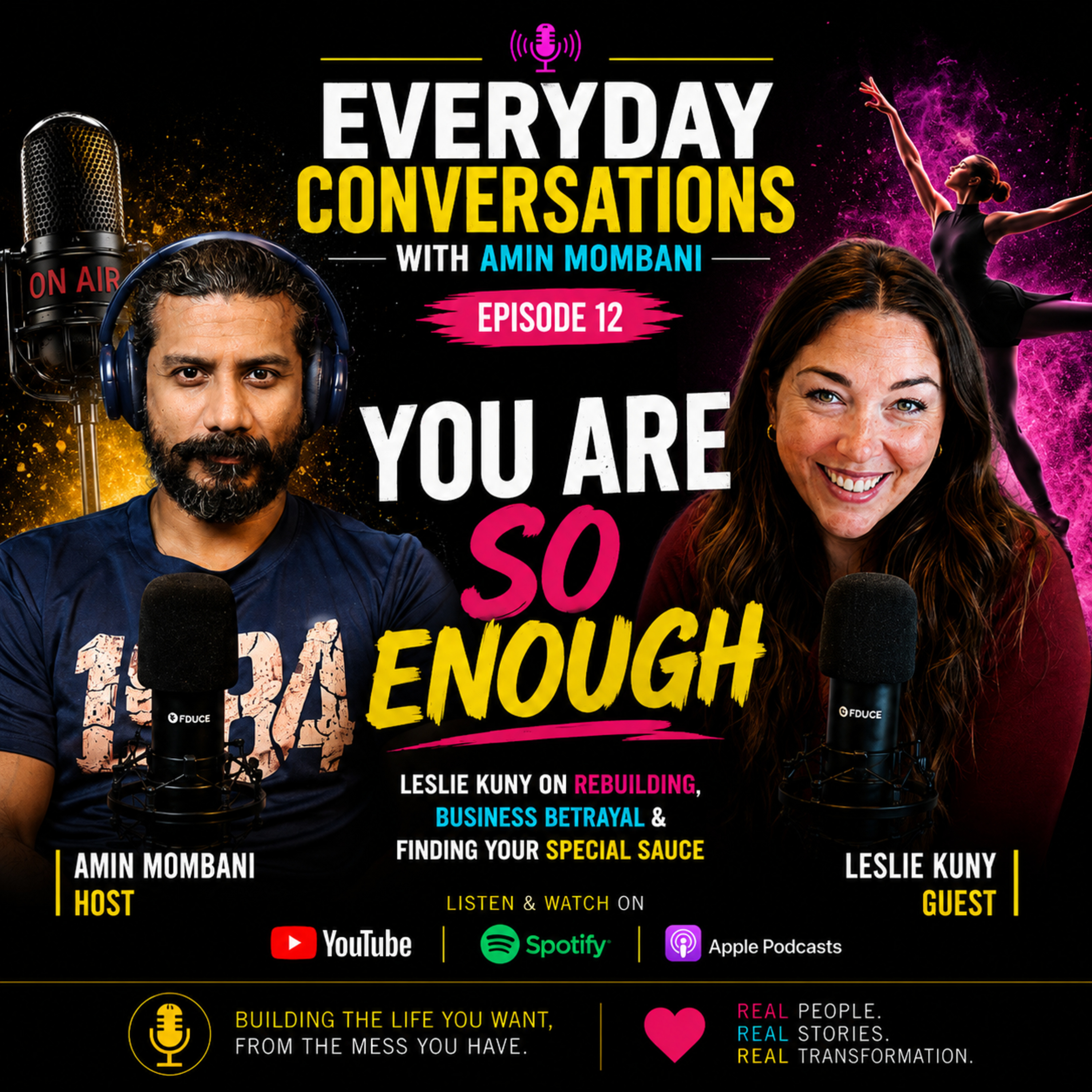
Ep 11 | YOU ARE SO ENOUGH – Leslie Kuny on Rebuilding, Business Betrayal & Finding Your Special Sauce | Everyday Conversations
She made a choice that was best for her. It also made peoplesee her as the villain.
Leslie Kuny is an award-winning dance educator and studioowner. In this conversation: losing every teaching contract in one year, walking away from a business partnership, and why she tells her students "Everything's made up and the points don't matter."
Follow the show so you never miss an episode. New conversations every Sunday and Wednesday.
💬 "That choice led people to see me as a villain." — Leslie
💬 "Everything's made up and the points don't matter." — Leslie
💬 "She danced through it." — Amin⏱️
Timestamps:
00:00 Cold open
00:40 Welcome + intro
07:43 Growing up in small-town Saskatchewan
26:47 Losing every teaching contract in 2017
28:50 The business partnership and the split
39:52 What it's like day-to-day at her own studio now
43:01 The student who reminded her why she does this
Connect with Leslie:
Instagram: @lesliekuny
Website: https://absolutemotion.ca
Contact Details for Host Amin Mombani - Host
Email: [email protected]
Website: https://aminmombani.podview.com
Youtube Link: https://www.youtube.com/channel/UCIoXPESGBAlhpbeWg_E7Hrw
Spotify Link: https://open.spotify.com/show/033CGyVtUGh2KFJ0MJypEZ
Apple Podcast: https://podcasts.apple.com/us/podcast/everyday-conversations-with-amin-mombani/id6782858287
CastBox: https://castbox.fm/channel/id7284639?country=us
LinkedIn: https://www.linkedin.com/in/amin-mombani-29979721/
Facebook: https://www.facebook.com/profile.php?id=61592072735008#EverydayConversations #AminMombani #confidencecoaching #smallbusiness #dancerlife #LeslieKuny #AbsoluteDanceStudio
Taking that action builds courage and builds confidence, building trust in yourself by doing teeny tiny little things and then looking back at the proof, like, oh, I did. That wasn't until my values were challenged that I was able to stand 10 toes down and say, no, that's not OK. But just like you are, so enough are your special sauce. And like, as soon as you can trust yourself and those abilities and the specialness that you have, holy smokes, Like, that's when the transformation happens.
Hello everyone, and welcome back to another episode of Everyday Conversations, and I'm your host, Amin Mumbani. So quick one before we start. If you haven't subscribed on YouTube, Spotify, Apple podcast or wherever you're listening, do that. Episodes dropping every week, twice a week actually, and the lineup is really solid. Stay tuned, Today we are looking at what it takes to rebuild your whole life from scratch through dance. Actually, my guest grew up in the middle of nowhere, Canada, where a love of dance made her the odd one out in a community that didn't quite know what to do with her.
But that didn't stopped her, it built her. She went on to become a professional dance educator, choreographer and a judge, eventually opening a business with a partner, splitting from that partnership, and then in 2024, opening her own boutique studio from scratch. Off the mic, she'll tell you that she's a Taipei High achiever with a soft spot for musical theatre, romanticy, novels and never turning down a baseball game. Interesting, actually. But on the mic, she's known for one thing above all, making people feel safe enough to just beat themselves.
Let's welcome her. Leslie Kinney, welcome to our video conversations. Hi. That makes thank you so much for that really, really lovely intro. It it makes me sound a lot fancier and more special than I really am, but I I'll take it. I'll I'll let it sink in. See I learned something from one of my mentor who was the episode 1 guest as well. He has his own conversation world actually, and that was named as awesome walkers. I asked him one day. I was like, I was like Samir Bhai, why you named this? Even I asked him in the episode as well.
So he said whoever walks in, they are awesome in their own way, in their own world. Yeah. So that's that's I'm telling you, you are awesome. Everyone who is coming as a guest in my show, I would follow the steps of Samir JP and I would say whoever comes in as a guest, they are special and they are awesome. And I, I, you know, jumping off that and sort of getting, getting the ball rolling. I do think that's true because everyone's integral to their, their community, whether it's their immediate family or maybe their work community or their social life community or their friends.
Like you are very important to a group of people. And it's it's sometimes really difficult to hold on to that and to feel that as a human some days, you know, but like, you are very important to these other people, you know, out in the world. And unfortunately, not everybody is is great at telling those people that they are awesome and that you are valuable. And like, I do like you being in my life. And so anyways, yeah, you just. PS you should do that more for your friends. Like, tell them, tell them, tell them they're awesome, that they're an important part of your life.
I'll say my all guests are awesome and I love them all. So let's just wait. We're not done yet. So like the the tide may turn on this one. OK, then I'll remind my listeners that in the end I'll say this word again.
So Leslie, tell me something. How is your day today? It's a Saturday morning, right? A weekend. Yes, today is a Saturday, which I I am dressed and I'm ready to be on camera, which is not normal for a Saturday. It's a summer, so because I have a teacher schedule I my day-to-day looks really fluid and because I'm self-employed, I can do whatever I want. That's not really true because anyone who's self-employed and owns a business knows that there's always work to do. So yeah, most days it's like get up, have breakfast, get ready.
Three times a week it's head to the gym first thing, not first thing. We're talking 10 AM. That's my first thing. I have a delayed time response just because of my job. So you know, 10, I try to be at the gym. I'm probably there for about an hour and a half to two hours. Then we come back, shower, have lunch and then it's and then it's business. So it's like emails or as you mentioned, right now, I have my my own business, Absolute Motion Performance and Dance, which is a boutique dance studio. And we actually just got our own permanent space we've been leasing from a Bhangra Academy that I'm close with that I know the owner and she was so helpful in, in sharing her space, letting me get off the ground.
And now I have my own space. But of course it means fixing the floors and painting the walls and making sure the taps work, these sorts of things. So some days I'll go to the studio and do some work. Some days I'm home doing emails, social media, whatever. Some days I take the day off because it's a nice day and I take my book and I go to the beach because come September I will not have that luxury. So I try to take advantage of it now, so every day looks different, which works really well for my personality and my brain, and it allows me to stay curious and genuinely inspired in what I'm doing.
So I never really feel bored, I never really feel tied down. If there's something I don't want to do, I don't have to do it that day. I will have to do it eventually, but yeah. So it keeps me interested and really involved and really inspired. I had a pattern in my show that I have to say thanks in the end. I think I have to say thanks in this time. Thank you for your time. Just come in my show.
I so you are my friends say I'm they're my again, like my friends think I'm really busy. I, I'm, I don't feel busy like I like to be busy. I like to I like to stay involved. I, I just recently auditioned for a play which I really couldn't have accepted the role because I'm already, you know, contracted to choreograph 2 musicals plus run my business and try to have a life. And then I was like, but maybe I could also be in this show like my friends were like, are you certifiable? I'm like a little bit, but I don't know any other.
I don't know any other speed. So there's a saying that tell us where are you from without telling where are you from? But you already said that before September you have to go to the beach, you have to do the readings and everything because after September you're not allowed. That's that was a good thing. Actually, Leslie, take me back to the middle of nowhere Canada. What was it actually like growing up somewhere where dance wasn't really understood? Yeah, it's so caveat because I, I, I have a lot of friends and a lot of family who are, who are from Saskatchewan, which is where I grew up.
I grew up in a small town called Martinsville when we moved there from Calgary, which was a, a much larger city than where I ended up moving. The town I moved to had 5000 people and I was a kid. But I remember looking around going like where is everyone? Like where are the people? And everybody looks like me. And I had come from a city where I had friends of all different races, ethnicities, backgrounds, like, and then I got to a place where everybody was just white bread and I was like, what's happening?
Beautiful people, beautiful scenery. Saskatchewan's very flat, lots of agriculture, really, really good people tend to be a little bit right leaning, a little bit fiscally conservative. It just makes sense with who they are, the economy they need, the type of jobs they do. It makes sense for that space. When I got there, I had come from a larger city and I had already known that the arts was my life like I was. I knew I would probably do something with ours. So I you just, I don't know, you're strong and resilient when you're young, even though it's difficult.
Like I danced all through high school. I was a competitive dancer. I did Royal Academy of Dance ballet exams. I was in theater, I was in student government. You know, I was very keen. I'm very keen. I'm very type A and I just love to perform like I really did. I loved being on stage because it allowed me to be seen. And even though I wanted to be seen for who I was, as long as I could be seen somehow, even if I was playing a different character or if I was doing something, you know, with my body in terms of like dance, I was seen, which is like detrimental in high school.
Like it kind of work against you because again, people thought my commitment was weird. I was made fun of for it. I missed, you know, things that like kids were doing, like I wasn't going to every pit party because I was like, I got to go to dance class. Like I can't. My parents are paying a lot of money to train me in this thing. It's not responsible for me to not go. So it just was a culture clash and my peers didn't understand it because they didn't have anything really. Like that being said, I will say there is a lot of talent in Saskatchewan.
There's a lot of talent in Saskatoon as well. There's tons of dance studios. There is a lot of talent. We just aren't able to stay there. So a lot of talented kids grow up there. Again, it's -40 for like the whole winter. So what are you going to do? You might as well be in a, you might as well be in a dance studio so you don't freeze. But but you do have to, if you would like a performing career, I think you'll have a better chance leaving the province, which is what I chose to do because I just didn't even with young people, like young people didn't believe in me and didn't think I had a future.
And I was like, well, if they don't, there's no way that, like older people who would actually, like, hire me or like do things would. So yeah. So then left, went to school, got some schooling and then just kept on keeping on because I was like, I don't, I just always want to do this. I know I always want to do this somehow. And it's, it's been a journey and there's been lots of different paths, but. How how easy is how easy is to do? Dance. It's not it's rough. It's like, hold on a second, let me backtrack.
Like any competitive sport, you can play soccer for fun. You can play soccer with a goal to GoPro or semi pro or play in university. So I, I do always want people to look at dance for sure. Acting not quite so much, but there is too like dance is its own youth competitive sport and there's also a recreational side. So if you're just doing it for the love of doing it, like that's cool. There's a place for you there and that's wonderful. And that's how most kids start. And then usually it like so young, like 8, between 8:00 and 10:00, you might get funnelled into this competitive side.
And then usually the kids that get funnelled into the competitive side stay because they love it and it suits their personality. Which is I, I always wanted to involve in dance. Not not as a pro, not as a stage one. Yeah, just just a normal family function, family gathering. My whole family is playing, you know, in our desi culture, even, you know, in Canada also the Indians and Pakistanis played their asura and the garba. Yeah, even that, that to make around and play with the claps and all that I cannot do.
Everyone is doing. And I'm just sitting on a side, everyone pushing me, pulling me inside and like, sorry, it's not, it's not my cup of tea. I cannot do it. I don't know why. And until now, till date, I cannot even my friends, when they go to clubs or parties, there's a you just need to stand up, you just need to jump and just need to do like this and dance. I was like, I cannot even do that. So I think you touched on something that's really important and I think a lot of people will resonate with is that dancing is incredibly vulnerable.
Even if you're just dancing at a wedding or at a family function or like you say, like at a club, there's something very vulnerable about. You're literally putting yourself out there and then moving your body, which like as humans, we do not do. Like we walk, some of us run and some of us lift weights or like, you know, like, well, like a normal human is walking around and driving and sitting at their house. So to be vulnerable and put yourself in that space is really, really difficult. It's really difficult.
It's really difficult, even if it's just a social thing, because there's a you're exposed.
I think it's because of lack of confidence as well. It might come because I know my family is super crazy. My paternal side, my maternal side are super crazy. And when then any marriages are there in the home, 2:00, three o'clock midnight, they're dancing, dancing, dancing. Don't stop dancing. And I was like, what the hell they are doing? I, I feel like, OK, I should jump in and I'll do nothing. I'll just take her out. And then I was like, no, people are going to say he doesn't know how to do, how to take steps and all that.
And he's doing small, small kids, my nieces, my nephews, they are doing it. And I was like I cannot do it. But kids are a lot more brave. It's a. Fear some. OK, now I'm on my podcast. Now I'm on my podcast on giving my voices. I'm on. I will definitely. I'll definitely give a try now. I think so. The fear is overcome. And you're right too, like there is a, there is a confidence that you feel like you need before you sort of step on the floor. And then the other side of that coin is that taking that action of trying and doing it, regardless if you're doing it like in a studio, in lessons, or if you're just doing it at a function, taking that action builds courage and builds confidence.
So if you can get over that initial fear, that initial barrier and just kind of like, OK, I'm just gonna go do like just jump in the lake, you know what I mean? Like just do it could because the action, the action creates courage and confidence. And it gets easier every time too, which is nice. Definite definitely this. I I resonate this and I will let a quote from my last previous guest actually, she said if you wait until you're ready then you will never do it. You just need to do it while you are scared.
Yeah, and it's. It's so resonating with this talk right now that I I immediately pull off my phone. It I oh OK hot tape I have AI have a love heat relationship with that quote because I get it at its essence. I understand it. The flip side of it is you've got to build the trust within yourself before you can take like there has to be something that anchors you to feel trusted and supportive before you do it. Because like, do it scared. Like, but I know like you hear that all the time and you're like, yeah, but I don't want to do it because I'm scared.
That's literally the reason. So, and particularly if folks, and I can only speak from my own experience, like I'm not an expert in this space at all, but as someone who struggled with their own mental health and a lot of anxiety and depression, hearing things like that makes you feel so much worse because you're like, I would love to make the effort. I would love to do it scared, but my nervous system is destroyed and I cannot. So I think that do it scared is great if you're not struggling with like other, you know, sort of deeper issues, but build building trust in yourself by doing teeny tiny little things and then looking back at the proof like, oh, I did that.
Maybe it's getting on the dance floor, you know, at A at a wedding. You're like, oh, I did that. Like I actually did that. There's the proof. There's a photo of me looking whatever. You know, like I did the thing. Yeah. That I did the thing. Yeah, Yeah, No, I was just gonna say those tiny little steps, those tiny little actions. I know for myself because I, I for a long time, I didn't trust myself. I had to look back to find proof, like proof that I did the thing. And then you can't really fight it.
You go like, wow, here it is in black and white. So my brain might be telling me a story and that's lovely, but it's, pardon me, bullshit because I have the proof right here. I did the thing and then I also did this, and then I also did this. So I found that really helpful in building my confidence. Just generally that I was like, Oh no, I did it and the world didn't end. That I wasn't like sucked into a black hole, like everything was fine. And that built trust and confidence. You have described yourself as a type, a high achiever, a drama encoded, a pop culture lover, and a high art practitioner.
How did all of those pieces are living in the same person?
Just lucky I guess. I think. I think it is a little bit of just like how I got was made, which is great. I love it. It is a bit confusing because I will sit and talk to you about hockey and baseball just as just as much as I'll sit and we can talk about ballet or or I can take you through an art gallery and talk to you about the paintings there.
Yeah, it is. I haven't really, really thought about this because it's, it feels so normal for me. I do think growing up, you know, in Saskatchewan, I had to, I had to find a way to fit in, to adapt. So making sure I could, you know, talk shop or whatever. I also went to, there wasn't, there wasn't a lot to do. There wasn't a lot to do. So we had a junior hockey team and they played like 10 minutes from my house. So I went and watched a lot of hockey. Again, growing up in Calgary, my dad was a part of the Calgary Flames booster club.
My dad also had no sons. Me and my sister and I'm the eldest so I always joke that I'm my dad's son so he kind of shared his love of hockey with me and and he'd and I again too, like my whole family like my dad grew up playing rugby and hockey. He's a tough guy and he was also in band and he loved to get, he was like such a Stoner, like weirdo. So he was also like a huge mix of people. And so I think genetically, some of that came down to me. And then my mom is from salt of the earth people from Saskatchewan, like her whole family's from Saskatchewan.
So she's very practical. And she worked at a theater for a long time. So there was there was some of that. So it was just, you know, it's, it's where you grow up. It's who is around you, you know, And being in dance for so long obviously fed that. And like, my parents took me to Cats when I was like 8 years old. That was the first Broadway musical I ever saw. And I got obsessed. So it was just a combination of the folks I was around. And then I also just really got into pop culture as a kid of the like 90s.
I was watching Saturday Night Live, I was buying people. I had all the teen magazines. Like I don't want to, I don't want to out myself how old I am. But you know, I had *NSYNC forever. Like I, you know, like it was just, I'm a product of the time that I grew up in as well as the people around me. So I don't know and I love it. But it also makes, I think people are confused when they meet me sometimes because I can, I can mud holes in the walls and paint my own studio and talk baseball and then also whip out a double pirouette and then also like, it's just all the things.
But I think a lot of people are like that. We have multiple interests and I think that's what is what makes people interesting.
That's pretty good actually. You said you left Coast and then you started your professional dance educator and choreographer. So what did that first chapter as a professional dance educator and choreographer look like?
Oh, it was rough. So technically I started teaching dance when I was 17 years old, straight out of high school in my in my hometown. And then I moved to the coast to for school and being a young dance educator, I felt like I really had a lot to prove and I really wanted to prove myself to people. Like I really wanted to be like, you know, and I wanted, you know, I wanted the advanced kids. I want to show people what I could do. And I think everyone early in their career, what, regardless of what like genre they're in that like mid 20s burst of like, I can do all that.
Like, and then, you know, you get a little bit older and you're like, oh, that was cute. Like, oh, sweetheart, you don't know anything. So there was a lot of hustle. And in Canada, at least I, I can't speak for everywhere else, dance educators or dance teachers are primarily contractors. So you have to go out and look for work. You have to hustle. And then also to like your contracts are only yearly. So you might work somewhere for a year and then they just never talk to you about renewing your contract, which is not cool.
Just talk to us. But it happens a lot. So lots of hustle, lots of trying to prove myself, and then a lot of taking jobs where I felt like I had to, which is fine because I do think that's part of the process. But then I ended up somewhere which was not like a fancy dance school at all, but it was consistent work and they weren't the most talented kids. And I became the best teacher through that job because I really figured out it was a really, really big learning space for me where I was like, OK, here is literally a kid off the street.
And now by June, from September to June, I have to get them to learn some steps. Remember those steps? Do it with the kids in their class to the same song on stage in June in front of their parents. How am I going to do that? Like really, really. And they're six years old, you know what I mean? So that experience at that particular studio was such a proving ground for me and really built my confidence being like, oh, I can do the thing 'cause I was there for probably 6 years, which is long for. It was long for me at the time, and I was really proud of what I'd done.
And I was able to see like the kids had grown through my work as well as my colleagues as well, who worked with those same students. And I was like, Yep, OK, look at those kids. They couldn't do that. And now they can do this. OK, I got it. I'm good. Which is good because then everything fell apart. And I got let go from that studio. And then my whole world fell apart. And I had to, like, refigure out what the heck I was going to do. But the confidence was was building there already. So. Yeah, the young.
So was so was that move eventually was the book that led you into the business for yourself? Close. So in 2017 I lost every single dance contract I had. I finished June 2017 with no, I had no contracts for September. So I had been working as a as a dance teacher for a decade already then and all of a sudden I had no jobs and I was like, who am I? What am I? Nobody wants to hire me. I've just finished some of the most successful years I felt of my career and I floundered for a little bit, for sure, trying to find a place to fit.
And so I worked somewhere where I was a ballet teacher, which is not, I'm not an accredited ballet teacher, but I'm a very good ballet teacher. So the years between 2017 actually was only really two years, to be honest, because then, then we all know. So like the next couple years were dicey for sure. Like I just didn't know. I was like, maybe I'm not, maybe this is the career transition. Maybe I'd go do something else. I, I'm not really sure. And then I was approached by a colleague, a former colleague, pardon me, in 2019, summer 2019.
And we got to chatting and, you know, she's like, oh, I've always wanted to open a studio. And I said, yeah, me too, except it's way too hard to do it by yourself. There's so much work. And she said, yeah, me too. That's how I feel. And then we were kind of like, do you want let's get together and chat, you know? And then it really took off like a rocket. And which was good and fun. And there were also tons of red flags. And I should have listened to my gut and my heart and my soul. And also everything's a learning opportunity.
So. So even though you know, building a business in the fall of 2019 with plans to open in March 2020, I am. I am that that is the date, that is the date when no one can forgot. I know no. And, and I mean like, it's wild. I can't believe it's my. When I talk about it, I'm like, I can't believe this is my life. It was our goal. We were working on our studio construction and renovation, getting ready to open March 2020, and we close our doors before we even open them the next few years. I mean, like it was, it was a bit of a challenge to be to be sure to try to run a children's dance studio during a global pandemic.
Like that was no joke. And we had no other. We didn't know any other way of running the business. We were following the government like we, it's not like we had run a business for five years, like a regular dance studio. And then we had to adapt. We just adapted straight from the jump. But you know, the stress and there's a, there's a lot about that. And then eventually, probably about three years in, it was just like I say, like from the jump, there were red flags and there were things that I should have stood stronger on and been a bit less compromising on in terms of, hey, this is a business partnership and I don't feel comfortable about this or I'm not OK with this.
But I love people and I will compromise and I assume the best of others, which can get me into trouble sometimes. And I just got to a point where our values, morals and ethics were clearly not aligned. And the toll that it was taking on me and my mental health was it was, it was rough. Like I could not continue in this way. And having learned about my business partner and who they were as a person, I was like, this isn't going to work anymore and I can't be business partners with you anymore.
Yeah. And then I went through like, maybe the worst year of my life in splitting from a business. And, and just as a heads up, as a like, I'd already lost a parent, like I already had like a dead dad. I'd already dealt with that. And this, I still feel like was the worst year of my life. It was just so, so hard and so rough and so expensive and really painful to. I think that's the thing that sits with me the most, is how painful it was to make a choice that was best for me. And I made the choice, and that choice LED people to see me as a villain and to make a choice to walk away from something that I built.
Sometimes, sometimes we have to take some steps, we have to go towards some point, some choices which we eventually end up in a, you know, in a pain, in a sufferance. But that leaves a mark. That leaves some teachings that make us learn something. Yeah, yeah. And I, as I was going through everything that goes along with, you know, leaving a business again because I had lost all my teaching contracts in 2017 and quite abruptly, like I will say, I was let go via e-mail from somewhere where I worked for six years, like not great.
So because I had already dealt with that, you know, at this point that was probably about, you know, there was a six year buffer. I was able to look back on that and say, you know what? In 2017 when I lost all those contracts, I thought that was the end of my teaching career. I thought I would never be able to do that again. And I was like, and look at where I am now. I built this studio. I trained these kids from the ground up. We are like award-winning dancers because they were all on the walls.
I was like, this sucks and I can do it again. I know I can do it again because I've already done it. It sucks and I can do it. And then 2024 came, where you open your own absolute motion dance studio. Yeah, yeah. And you build it from scratch. Pretty much. We're still building. Yeah, yeah, yeah, I did. How does it look like day-to-day? Well, it's, it's really lovely. I say we're boutique because we're not for everyone and we're not super big. We do offer a lot of classes, but the folks who are coming to us are coming because they see what we offer, which is real people who care about real people.
Zero drama. We're not doing, we're not doing dance drama. We're not doing Dance Moms. And while I know what I can do for kids in terms of training them to be technically incredible dancers, which they will be, there's no doubt about that. The thing that's even, oh, do do not cry. The, the thing that's even more important to me is making sure that those kids feel safe and supported and confident and that they are growing into good humans. So that when they leave my studio, if they leave or even if they go out in the world, even right now, as if they're like a, you know, a student of mine and they're out in the world.
I want the people that they interact with to be like, wow, why is that kid so kind? Or wow, why is that kid so nice? Oh, that kid invited me to this. And I hope I can be a teeny tiny part of building that person into a kind, confident human out in the world. I'm the rock. I say this all the time. I'm like, I'm the Rock You throw into the water and it ripples out. My students, my clients, the people that I interact with are the ripples. And that's like, yeah, it's my heart.
So that rebuild wasn't just about the business, it actually shaped the way you teach them. Oh yeah. And I I hadn't really realized I was doing that. Like I was doing it for a long time. I didn't realize until I went through a bunch of nonsense that that was that. That was my Moi think, you know, a lot of people are like, oh, that's so unfortunate what you went through. And I'm like, yeah, it is. It really sucks. And I feel like it's not until, oh, it's rough and people can disagree with me. Let me know.
But for me, it wasn't until my values were challenged that I was, that I was able to stand 10 toes down and say, no, that's not OK. This is what I stand for. This is who I am, and this is how I'm going to walk around the world. You don't have to, but I have to be OK with this. Like, so, yeah, which is great because then too, like when you, when you live in that place of authenticity and you're standing on the values and ethics that you know and believe to be true, nothing feels like it's just so much easier.
And I and I knows are saying no is easier. Saying yes is easier because I'm always checking in with myself if it lines up with like who I am and who I want to be and how I want to be seen and felt in the world. Yeah, makes life easy. You have said that you are known for being an encouraging human who doesn't take anything too seriously, and that I already know right now, so how does that actually show up in your studio? Oh, great question. Yeah, so I this is how I am with like I'm a little bit cuter.
I'm a little bit more of a Disney Princess when I teach the little guys, but one is just allowing myself to be myself in the studio. So I'm a little salty, I'm a little sarcastic. We're always having fun until we're not working hard. There's always a balance. But just allowing the kids to see my authenticity allows them to see their authenticity. And so and also to like, let's be so for real. This is children's dancing. We are not curing cancer. I'm not sending folks to other planets to find out if we can live there.
Like, we're not trying to like, solve the water crisis or climate change. This is children's dance. So take a step back and just be like, these are memories that kids are going to take with them forever. So especially because I grew up in a dance studio, so I'm always thinking, how do I want them to reflect on their time 'cause they're gonna remember. We all remember, you know, coaches and these people of importance and authority in our lives and how they made an impact on us as kids and then how we feel about it as adults.
So I often will, I joke, we're joking all the time. It's a very, it's a very sassy studio, not in a, not in a mean way, but in a, in a, in a, in a fun way. I often, I often say to the kids, you know, they'll get, I'll be like, OK, we're going to do the thing. And they all get really serious. And I'm like, Oh my gosh, don't you dare, don't smile, don't laugh, don't and absolutely do not have any fun while you're doing this dance. And they immediately start giggling, of course, right. Like as soon as I like, force them to be really serious, That's exactly when they realize, oh, this is a safe space.
I don't have to be, so I don't have to be so serious. Lots of that, lots of joking around. If I make a mistake, I laugh at myself. I let the kids laugh at me. We everything's like nothing's that serious. It's just not. And I, this is a new I've always loved this line, but I say it a lot now to make people feel better, because dance is supposed to feel good. Dance is supposed to make you happy, and it's real. And in some ways, you know, it's really shifted away from that, especially in the competitive world.
And I think that's true for any youth competitive, anything sport, art. But I say, I say to my students, regardless of how old they are, I'm like, everything's made-up and the points don't matter. It just doesn't like the people who love you when you go home are still going to love you. You're going to go home to your house and your dog and tomorrow you're going to go to school and your friends are still going to be there. If you make a mistake today in this 2 1/2 minute dance, it is not the end of the world.
And what really solidifies that for kids is me still liking them afterwards because they feel a responsibility to me to be perfect. So by me. Being kind and open and fun and not making a big deal out of the mistakes. Just being like, OK, let's try it again. They're learning that they are still loved even when they're imperfect, which is absolutely true.
You mentioned building confidence in young dancers while healing your own story at the same time, so can you unpack that? Yeah, it's kind of like that, I think. I think teaching kids, working with kids allows you to see the best version of yourself because they love you. Like, it's crazy. Even when I'm having a bad day or like I'll be mad at them or but usually it's just frustrated at myself. It's not. I'm not really mad at them, but allowing them to see, allowing them to see who I am. So the sassy side, the excited side, the frustrated side, and that those feelings and emotions do not have to derail my progress or my day.
They're just a moment and I let them exist and then I let them go by. And I think my, I'm healing my self esteem and my own dance related. I don't wanna say trauma. That's like too big of a word, but just the hang ups that come through youth and puberty and being a, a young woman and like standing in front of a mirror for like hours a day in tight clothes, like Yikes, what a disaster for like self esteem. But I think the fact that I'm able to influence and encourage young dancers so that they never, so that they don't, it's not that they won't ever, you know, have moments of of self doubt, but it's my job to build them up.
Like I know if I'd had a little bit more of that in my life, if I had people saying, you know, if I said something unkind about my body or unkind about what I was doing, if I'd had more positive reinforcement, I would have turned out to be a totally different person. So I just see the potential in doing that for others. And by doing that through others, I'm healing myself because I'm seeing that nothing was wrong with me ever. As a young person, that was all that was like 100% a story. And yeah, so by doing that for others, you do it for yourself.
What's a moment with a student that reminded you why you do? This there's honestly there's so hey, hold on, There's so many. I feel I feel so honored to be able to have such a special relationship with so many kids. I'm going to talk about I'm going to talk about Katie because she's a student of mine that reminded me so much of myself, like heartbreakingly so. She worked really, really hard in her preteen teenage years to and she really became a strong dancer, but she did struggle with self esteem, even though she was growing so well as a dancer and there was so, so much quote UN quote success.
You know, we could really see her growing and getting really, really good. And she and I work together on solos. So we've gotten very, very close. And again, I saw myself and her. So I was trying to coach her in a way where I was like, I feel like I know what you need and what you need to hear and I hope I can be that for you. And then a year we had a jazz solo. She had a jazz solo. She'd been doing really great. It was a very difficult dance. And we went to a competition and she'd been doing great all season, like really great.
We were really proud. And every, you know, every performance she was getting, she felt really good about her performances. We went to a competition, she does her dance. I thought it went great. She felt like it went well. We were like great, awesome. And then it came to getting our medals and our standings and our placings and she did not place well. I think she, I think I don't even remember. We expected like, you know, a first, second, third. And she didn't. And we were like, I was gobsmacked because I was like, well, she's pretty good.
And I watched everybody else. So OK. But she was really, really hurt. Like it really, really got to her. And she she did. I'm really proud of her. She did keep it together. But as soon as she got off the stage, the dam broke and she just, she felt like she let me down. She felt like she let the studio down. She felt like she let her parents down, everybody. She just felt horrible. And that was a moment where I got to 1, Reassure A talented kid that they are talented and two, where I was like, you and I both know you did great and they got it wrong.
Sometimes they get it wrong. The adjudicators, they just whatever I was like, but you and I both know how well you did, so we're not going to let this outside information destroy us. And it really kicked off. I do think that conversation and that experience really kicked off a journey for her of self acceptance and being like, yeah, as long as I feel good about what I did. Yeah, it's great to get first place, but it's not the be all and end all, especially if I'm proud of what I did. And that was such a huge thing for her.
And it's like, it still makes me like so proud. And now she's like quite. That was probably like about four years ago. And now she's like way better adjusted and like I love her to bits. And I just like that moment. It just, it just resonates with me so hard because I knew how she was feeling in that moment. And I also wanted to let her know that, like, how she placed didn't mean anything to me because I was so proud of what she'd done on stage. Yeah. That is a sign of the greatness and the great teacher, actually.
It took a while. It took a while because when I was young, I wanted to win all the things I wanted to. I thought that that's what was going to prove to me that I was good. And now the proof is the parents who are so happy and text me and say our daughter's so happy or thank you so much for everything or three years out, you know, they message me and say, Hey, how do I so and so is auditioning for something? Can you help us with their, you know, like that's, that's the joy now is the relationship and the and the things that I'm able to impart and share and just the impact I make on those kids lives is massive.
So let me tell my listeners that Leslie has whole another side also. So let's shift some gears completely right now, Stuart. So musical theater and Broadway, where did that obsession start? And what's the show you would make everyone watch? Oh. My gosh. OK so I did mention I did see Cats when I was very young when I was 8. Cats the musical, the original Andrew Lloyd Webber. I know there's a new Jellicle Cats version which I have not seen. I'm sorry, but Cats is my favorite musical. I saw it. It's an all.
There's not a lot of spoken dialogue. It's all singing and dancing, which were things that I love doing. And I saw Cats and I went, that's what I want to do that whatever they're doing that that's for me. And then I don't know, I really, I got into drama like in round grade 6 and I just the idea of being famous was very appealing to me. So I was a bit delusional from the jump whether it was like going to be movies. But then because musicals were singing and dancing and acting, I liked the fact that they were all three.
And I just really got into it. And again, like my mum worked in a theatre and we bought cast albums. Like I listened to Phantom of the the soundtrack for Phantom of the Opera, like from the time I was like 10 a show. I do OK. There's so many musicals that I love. Again, really, really nerding out Book of Mormon is like #1 I think it's so funny. I think it's so good. But something that's more accessible ish for folks. And it is on Broadway now, but it actually started as a television show. So there's a television show called Shmiga Doon.
It's on Apple TV and stars Cecily Strong and Keegan Michael Key from Key and Peele. And it's phenomenal. It's a satire, parody love letter to people who love musical theatre and they don't take themselves too seriously. And the songs are great and they've got like Kristin Chenoweth is in it and Aaron Tevitz in it and Dove Cameron from The Descendants and Alan Cummings. And like, it's just great. And it was filmed in Vancouver. So like I also have like a love for it because I've there's a couple people I know where I like point them out when I'm watching it.
But Shameika Dune is like so fun and so funny and doesn't take itself too seriously, which I like because I think people in the art get pigeonholed in that we're like very aloof and very pretentious and very hoity toity. And that's so not, that's not it at all. Like we're just big goofs who want to sing and dance. Like, so yeah, should make a Doon on Apple TV. Highly recommend. And it's pretty accessible because you don't have to go to Broadway, just watch it. You have done a fair bit of travelling in Europe.
Any trip that change how you see things. Oh, oh, that's oh, yo-yo, yo-yo, yo. Well, I mean, going to Italy is always fun because it's the, the rules are just not as rigid and things are way more fluid than say, if you go to Germany, where like everything's run by the book. Even Switzerland, even the Netherlands a little bit actually, I would say I'm like, you know, when things are happening, Italy, you might be like, let's find this restaurant and you're like, that restaurant doesn't exist anymore.
It's just I wonder. I will say I've travelled a lot to places where English is not the first language, which is fun because then I get to practice phrases in other language. In the last year I went to the UK and it was actually a bit off putting because I could hear and understand everyone's conversations everywhere I went and when I travel I'm not used to that. People are talking around me. I have no idea what's going on. I went to the UK and I'd be sitting at breakfast and I could hear that person's conversation.
And I was like, oh, I, it was like a reverse culture shock because I'm so not used to understanding what people are saying around me. Or, you know, I'll find little snippets, but I wonder, I mean, everywhere you go, and this is what I love about travel so much is you get a little insight of like what, what life is like for other folks. And like, because I do try to stay. I mean, you got to do the, you got to do the touristy things. But then I also like to just stay in a neighborhood for a couple days and, and figure it out.
So there's always something to learn. And I always come back with something that I'm like, Oh, I like how they did that. I'm going to bring that into my life like these little things. And that's what I like. I feel like I'm collecting not personality traits, but like new little rituals, things that I can actually keep with me from my travels that I can then share with other folks.
You call yourself a romanticy reader and a Brooklyn 911 coder. What's currently living rent free in your head pop culture wise? Oh no, everything's living rent free pop culture wise. So I'm currently reading the second book in When the Moon Hatched. Ballad of Falling Dragons is what I'm reading right now for the for the Romanticy book girlies. So I've read all the Acatar, Crescent City, 4th, 4th wing. We're reading all those things, pop culture, what is happening? I don't know. I will say right now I'm listening to a lot of good hang with Amy Poehler again, 'cause I love Amy Poehler and I, I love Parks and Rec and I, I'm half less.
I would say I'm like half Leslie Knope, half Jake Peralta from Brooklyn 99, like those two parts of my personality. And the other pop culture thing I would say that is is front of mind is also the Seth Meyers Lonely Island podcast where it's the three guys from The Lonely Island and Seth Meyers, who is the host of Late Night. And they're talking about all the digital shorts that The Lonely Island made when they were on Saturday Night Live, which I watched when they were out. So, so it's, it's a combination of pop culture and nostalgia and also behind the scenes of making these hilarious things that, you know, we, we, I, I shouldn't say we, I don't know who else, but like I'm on a boat or I just had sex or the creep, like all these threw it on the ground, like all of these weird digital shorts that I like, loved.
And now I can hear about the guys who made them and like what they're doing. So it kind of like brings you in and you feel like they're your friends even though they don't know, they don't know who I am.
Just a quick one, if you have to pick baseball game or Broadway show no contest allowed. Which one wins and why?
Oh, I don't know, a baseball game's cheaper, I think on the whole. Also, who's playing? Because if it's the Red Sox, it's going to be hard to turn that ticket down. That's a real toss up. I think it depends on the day. Oh, I that's like asking you to pick your favorite kid. I don't know. I don't know. I really. Oh, that's bad. I'm really sorry. I'm very indecisive when it comes to that. Oh, I can't pick. I can't pick. I'll do both. I'll go to the ball game during the day and then we'll go to the musical at night.
Found a way around the system. Here comes something. Here comes something really fun. You told us that you are hilariously bad at understanding how airplanes work.
So if you had to explain A5 year old why a plane doesn't just fall out of the sky using only dance terminology, what would Leslie say? I would say, kid, you got to go find somebody else to talk to. I truly, I am so bright in so many ways, just not in the way of physics, the physics that don't pertain to the body. I have been told that there is something about the air pressure on the top and the bottom of the wings that keep planes in the air, I guess. Sure. OK. Like, I don't know. What the heck do we have those big jets on there for if they're not keeping them?
That's. Yeah. So like, I don't get it. The air is air. Again, everything that I just said, how smart I sounded this entire interview is all going out the window right now. It's just really tricky for me to like understand. I did have someone explain to me one time that because the air is denser, you know, the further away we get from the ground, that it's almost like, think of the air like jello. So it's, it's thick air. So when you get turbulence, think about a plane in jello. It's not going to fall out of the jello.
It's just going to bounce in the jello. Sure, Like I am trusting other people that that that is like accurate science. But it does help me feel a little safer when I'm flying and there is turbulence. I'm like, I'm in jello, and that's where I like my meditative state that I go into and I just imagine. I'm in jello. At least something is working as a jello. Fingers crossed. Leslie, if this episode could change one thing for one person even listening, what would it be? I hope.
Oh man, there's so many things. Sorry my brain just started firing so fast. Just like you are so enough. Nothing about you is weird or wrong or whatever negative thought process has been put on you because we don't start that way. You are just so enough. And the thing that you think is weird about you, the thing that makes you not who I'm going to cry. The things, the things that make you not like the other people are your special sauce. And like, as soon as you can trust yourself and those abilities and the specialness that you have, holy smokes.
Like that's when the transformation happens, and that's when you're going to be unstoppable because you are. You just have to trust in yourself that the thing that makes you sparkle is needed. And it's so needed and we need it.
Leslie, where can people find you and follow what you are building and if they want to get teachings from you? Oh well, I'm on Instagram. Just my name at Leslie Kuny LESL i.e. KUNY, my website, islesliecooney.com and the studio is absolute motion performance and dance. The Oh, here's absolute Oh, my website. I was like, what is my website? absolutemotion.ca. If you live in the lower main line, great. If you don't, but you also like vibe with me. Like we have technology now where I can do and also I taught over Zoom during the pandemic.
So if you're a dancer and you want feedback on like what you do, we can do Zoom. Or if you want to just like learn to dance over Zoom, like we can do that. Like just connect with me. I'm so here for people like, and I'm just a normal person. Don't be weird. Don't don't feel like it's weird to reach out to me. It's not like hit me Adm My e-mail is [email protected]. It's a brand. It's a whole brand. Yeah, and I just welcome it. If you enjoyed the chat or just whatever, like hi, I'm a totally normal person just like you.
I'm just happened to be on this podcast and I just happened to do this as my job. Like it's I reach out. It's not weird. Love it. Here is what the conversation reminded me of. Rebuilding doesn't erase what came before it. It's just for you, true. It just give you a stronger floor to stand on. Leslie didn't get to skip the heart chapter to get to the studio. She has now. She danced through it. All of Leslie's details, which she's mentioned a moment ago. I'll put down on the show notes, her social, her website, everything, and all the ways to contact her.
And she's so people's person that she will definitely get back to you. I will and reply you Leslie, thank you for such a fun and amazing hangout with me. This generally felt like a coffee date with a friend exactly like you. Hooked. It.
Thank you so much. Awesome. Thank you, Amin. This was wonderful for. Everyone listening, go find Leslie at. Leslie Keaney at gmail.com and Instagram. Leslie Cuny and check out Absolute Motion Dance. Until next time, this has been everyday conversations. Goodbye.
 Apple Podcasts
 Castbox
 Castro
 Goodpods
 Moon FM
 Overcast
 Pocket Casts
 Podbean
 Podcast Addict
 Podcast Republic
 Spotify