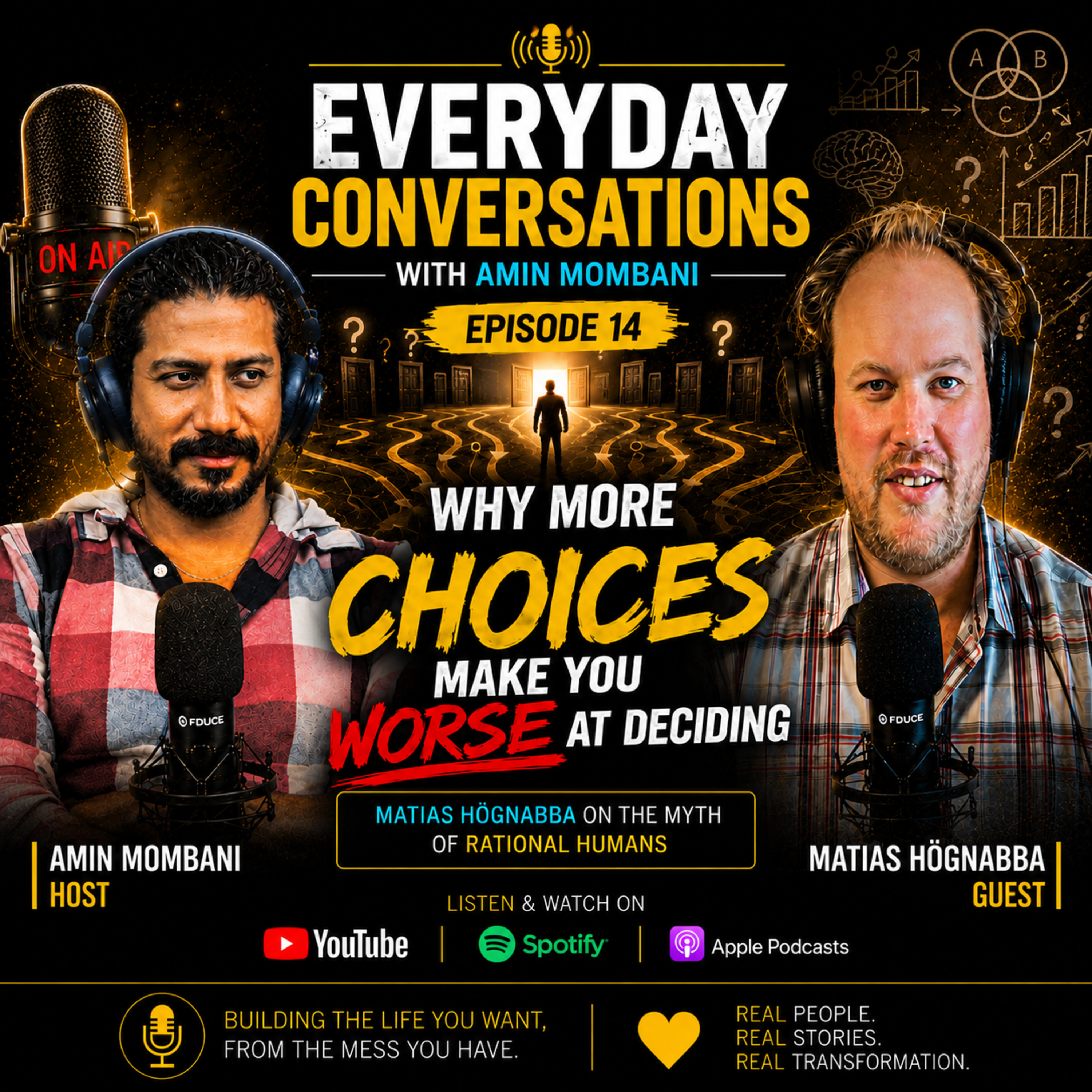
EP 14 - WHY MORE CHOICES MAKE YOU WORSE AT DECIDING — Matias Högnabba on the Myth of Rational Humans | Everyday Conversations
Two to three years of unemployment can break a person, or itcan force them to rebuild from scratch. For Matias Högnabba, it did both. In this episode, Amin talks with Matias — a decision-making consultant and self-described "anthropologist at heart" — about the long stretch ofjoblessness that pushed him into entrepreneurship, why he believes most of what we call "rational" is actually built on ignoring how humans really work, and why he's convinced AI will never be able to replace him.
---------------------
🎙️ In this episode:
· What two to three years of unemployment actuallylooked like from the inside
· The first business idea that failed — and thepivot that led him to decision-making
· Becoming "an anthropologist at heart" without ever getting the degree
· What an executive bubble looks like from the outside, before anyone inside notices it
· Poor communication: the single most common decision-making bottleneck across every industry
· Why rigid societal structures ignore basic human nature and biology
· Social media, misinformation, and AI-generated content — the downside of technology we built to help us
· Why AI can think faster than a human but will never replace what he does
· What it would actually take to create real, large-scale change
· Wildcard: hilariously bad at woodworking, despite his mom being an expert
------------------------------------
💬 "It's the humanity, really, and emotions — a machine cannot have emotions like a human can." — Matias Högnabba
🎧 Watch the full conversation on YouTube:https://www.youtube.com/channel/UCIoXPESGBAlhpbeWg_E7Hrw
-------------------------------
Contact Details for Guest
Matias Högnabba — Decision-Making Consultant & Strategist
Website: Decision-Making Consulting | The Pragmatic Realist
Contact Details for Host
Amin Mombani - Host Email: [email protected] Instagram & Threads @Everyday.ConvPodcastWebsite: https://aminmombani.podview.com Spotify Link: https://open.spotify.com/show/033CGyVtUGh2KFJ0MJypEZ Apple Podcast: https://podcasts.apple.com/us/podcast/everyday-conversations-with-amin-mombani/id6782858287 CastBox: https://castbox.fm/channel/id7284639?country=us LinkedIn: https://www.linkedin.com/in/amin-mombani-29979721/ Facebook: https://www.facebook.com/profile.php?id=61592072735008
#EverydayConversations #DecisionMaking #ExecutiveBubble#ThinkForYourself #AIvsHumans #LeanThinking
So more options does not mean a better decision making. It's actually the opposite. So the the optimal amount of options would be like 3 or 4. So, but like when you have hundreds or even thousands, you can imagine it, it becomes very, very hard. Hello everyone and welcome back to another episode of Everyday Conversations and I'm your host, Amin Mumbai. If you haven't subscribed yet, go do that. New episodes dropping every week. So today's guest, he has spent a long stretch unemployed, rethinking everything and came out the other side as a decision making strategist who helps companies break their own rigid structures.
He calls himself an anthropologist at heart, and he's here to make the case that most of what we call rational is actually anything but. So let's welcome Matthias. Welcome to IBT CONVERSATIONS. How are you? Thank you very much, I'm doing great today. The sun has been shining and a bit warm outside. So how's the weather in Finland? Is it good or hot? It has not been hot this summer. It has been well rather a mild summer and we haven't had any big heat wave or so, but very quite dry and don't finish standards quite.
I wouldn't take cold but chilly at times. So we are talking about temperatures below 25°. That's amazing. And we are having in Dubai like around 40°. Yeah, that's a a huge difference. Huge difference. Yes, yes, I think like Finnish people would melt in such heat because we are not used to those those kind of temperatures. So I mean, I'm quite happy with the temperatures we have had because it's not too hot. You can't do something like outside without, well, burning or just feeling sick all the time.
So, yeah, I think it has been a great summer in that sense. OK, I mean, somebody they like hot and so on. But Finnish summer is quite short. So yeah, sure, I can understand that. But I mean, enough of people like the Finnish people are not really made for the very hot days. And, and I mean, like I said, you become lazy. You just want to lay in your bed, be outside in the shadows. If it's like too hot, cannot really do that much outside. Like, I mean, because the summer is so short in Finland, of course we want to be outside as much as possible.
That's great. So how was your day at work today? Yeah, I think like, I mean, I had, I've had a day off really from work today and and focused my time in the garden, harvested apples, lots of apples. I have a very Big Apple tree. So it took like a whole day to pick the apples from the tree and tomorrow they will become apple juice. That's. Great, healthy life. So Matthias, you have said that a long period of unemployment made you rethink your options and consider entrepreneurship. So what did those months actually look like from the inside?
Yeah, I think like it was 2, three years actually. So I mean it was a quite a long period of of well doing nothing. But I mean that does not really do justice to to that period. Of course I did stuff, but it was something else that work. So, yeah, like in the beginning it was OK, I mean like first 6-7 months or that the first year, but after that started to feel OK, I'm stuck. I need to do something, I need to figure out something to well, keep me going really and taking me somewhere in my life.
So it was a a struggle. And I mean, lots of applications and applications and, and really trying to find a job, but I mean, well, it goes without saying that the longer you're unemployed and so the harder getting a job becomes. So I think that's what happened to me. And also your mind starts to wonder, OK, am I qualified? Am I able to get a job? Am I attractive on the on the job market? And so maybe do I apply to the right kind of jobs and is my applications of a good quality and so forth, You know, so I mean, at some point I started to to look at my options, OK, what can I do?
Is there something that I can do myself to end the unemployment? And I mean well there are there are not many options you can do that by yourself. So really the only one is to become self-employed, and that means starting a business, so. So what was so? Yeah, go ahead. Well, I mean, before that period, I hadn't considered entrepreneurship as a viable alternative for me. But I mean, well, the situation kind of forced me to reconsider my options. So what was the first idea that eventually became the work you do now?
The first idea was something like not not teaching, but like offering help and I mean like like for for households help in like applying the lane thinking in like well how they spend their money and and time they think it was. So I am a, a, a big fan of lane thinking. So I started with that, but and like of course I did some research, market research and so but at well, after some time I came to a conclusion, OK, this will not work so well. I had two options. The first one was to to well, give up, put my hands up and so, and the second one was to, to change and modify the initial idea.
And that was that was what I did. So I started to to change it and well, I think at some point I figured it out that if I want to help like my my customers to apply the lean thinking, I need to help them choose like a lean well person or you know, so that was when I got into decision making and, and became interested in decision making because decisions lie behind every action we do. So yeah, I mean, it took a while to figure that out, but well, fortunately I did. And well, since then I have studied lots of decision making and really how human work.
So it has become a passion. So you call yourself an anthropologist at heart, even without the official title. Where did you that? Where did that instinct to study people come from? I think that has been inside of me for a quite a long time, but I think that I haven't just known the word or or term for it for a long time. I have studied 1A long course of anthropology in one university in Sweden. But I mean, but yeah, I have no degree in anthropology and so on, but I have the mindset really I'd like to to study human, observe human and I mean anthropology means study of human like in Greek to Greek words combined.
So yeah, I mean, yeah, I'm just saying very curious minded and very curious about the human and the life in general, really. So that instinct is basically the whole engine behind what you do for companies right now. Yeah, yes, it is. So I combine the lean thinking and like my my itinerary background and the anthropological mindset and approach. So yeah. So you help companies break the executive bubbles and make sure that every stakeholder is actually heard. So what does an executive bubble look like for the from the outside, before anyone inside it notice it's there?
Well, you could say it's some kind of ignorance or maybe selfishness. So like you, you refuse to, well, look outside your own office, for example. So you stay inside your old office and, and you, you think things by yourself or, or with your like fellow managers or, or the board. So, but a, a, a company, especially a bigger one is much more than the leaders and the board and there's lots of more knowledge available within that organization. So it really means that you live in your own bubble and you kind of refuse to see beyond or outside that bubble really and consider all the people of the stakeholders that the decision you are about to make make it will be affected.
So it's really just to to admit to yourself, OK, I do not know everything. Your tagline talks about eliminating decision making bottlenecks. What is the most common bottleneck you see across the across completely different industries? Poor communication and style. So poor communication you think is the most important bottleneck or most common one? Or you can save both. Yeah, yeah, it's the most common one and it's the most, well, dangerous one as well. I mean, if you want to make quality decision decisions and involve as many stakeholders as possible, the communication is the absolute #1 thing that needs to be in line and working if you even dream of succeeding in that task.
So studying human behavior inside the corporate and on the other side, if we say leadership coaching or executive leadership coaching, does this both does the same work or they are not similar? I do not focus on that leadership coaching or, or so I I focus more on the, the information flow and the structure of the organization. So like if the structure can be in the way or enable a good decision making. So really the structure should serve the, the good communication. And so like, I mean, good communication is not important just for decision making.
It's for overall well-being of the organization. For example, it's very important for for like emergencies and this kind of stuff. So I mean, if that does not work, the the organization do not work either. So I'd like, I mean the, if you think about the anthropological side and understanding the human, well, for an, an individual, you, it's good to know how how a human being makes decisions. But like, if you have many people, it's good to be aware of the group thing. And, and I mean, if there are many stakeholders in involved, it becomes hard to make decisions.
So ultimately the final word is within the management. And so of course, but like the, the point here is that the management, they need knowledge from other people as well in order to be able to make like qualified and well, you could say well-rounded decisions. So it's possible that if they do not look outside their own office and ask some other people, they may might make very big mistakes because some small detail was ignored or that they did not know of the existence of this piece of information that could have been found out just by asking.
While chatting with you before the episode starts and now also till this far, I noticed that your calm personality and as you know also that you are known for calm personality in rooms that are often anything but calm. So is that natural or something you had to build it? I mean, well, the calmness has always been there. I'm a very calm person, maybe a little bit introverted as well, OK, But maybe nowadays not so much because I have to grow outside of that introvertness and to be able to talk to people.
And so like I have always been comfortable talking to strangers and so and well, nowadays I speak with lots of people around the world and so, so I've been become comfortable with that and so. But yeah, I am a very calm and peaceful person, like all the time. If not necessary, it should be something else, but that's very rare. So Matthias, that this work is really built on one bigger idea. Hope you are ready to go deep on that. I am. So you have said that you built, we build rigid structures and rules that completely ignore basic human nature and biology.
Can you give me a real example that you have seen up close?
Well, I mean, we can see it every day really. And well, maybe that the best example of this is our society submits. So we can see it every day. We can be a part of that system every day. So we have like many layers of structures in the society. Like we have the, the municipalities, we have the regions, we have the state level. Now we have like in in Europe, we have the EU and, and this kind of sort of many, many layers. And like this is the the like best example I can give off a a complex and also a quite rigid system that's well, I mean, there are lots of issues that do not well meet the criteria for good decision making or for a good decision making system.
And I could talk about that like for hours, but I will not do that today and all right now. But the biggest issue with the societal, societal decision making systems as well, it's the scale. So if the scale is big, then it is really hard. You have lots of stakeholders. The information tends to get stuck the way and also the human ability to like understand the scale is limited. So if the scale is very big, like global for example, it's impossible for humans to really understand what it means because it's not like tangible or we don't have a good reference reference point.
So, and I mean, yeah, so too big, too complex. It's like it's not made for good decision making. And like for well, OK, you can debate if is it if it's good for human, Well yes or no, there are like pros and cons depending how you approach it. But like if we start to look back a little bit where we have come from and what we have been for the most, most of the time in our history. So we eliminate a society that has not existed maybe like 2 or 300 years, you know, But like, if it go like more, more than like, well, if it goes some thousands of years.
Back in time, we see that the societies are very different. I mean the amount of people was much, much smaller. So and like initially humans are not made to live in this kind of societies and this type of life we are living right now. So it challenges us like biologically, but it also challenges the the environment and the planet. So it's both unsustainable for us as species, but it's also unsustainable for the environment. So like, I mean, if you think you're about your personal decision making, you have lots of options, for example, to choose your education, like universities offer lots of programs you can study and, and so, so it's really hard to decide, OK, I want to study that.
I want to do that when I graduate, I want to have a certain type of career and so on. Oh, but that's a problem really from a decision making point of view. So more options does not mean a better decision making. It's actually the opposite. So the OP, the the optimal amount of options would be like 3 or 4. So but like when you have hundreds or even thousands, you can imagine it, it becomes very, very hard. So like, like in the modern world, we have lots of options, but but that's, that's really a problem.
And like we want to have lots of options because we think, OK, that's better for us. And it, it, it offers the possibility for an individual to find their own path and, and to, to really find something that resonates with them. And so, but that's really not the case. So like the the complexity and the surplus of options is a problem for humans. So if most of what we call rationale is actually built on ignoring humans actually work, or ignoring how humans actually work. Yes, 100%. So why do these systems keep getting built in the first place?
That's an excellent question and well, I can think about a a couple of reasons. The human being is, I mean, the human being loves control, predictability. So and that means kind of ensuring safety and security. So, and I mean the human being is well, kind of the only species that has has an advanced technological capabilities. There are other species that make some kind of technology, but like the human being is well, well, well above the the rest. So basically, if you think about technology in in the among all species primates, of course, the the most advanced on that front and humans are the well, kings and Queens to to put it that way.
So, yeah, I think like because we have the this ability to imagine and also we possess the ability for logical thinking, reasoning really that has LED us to to create lots of technology which we think will help us to have more control, bring more safety, predictability, also make us live longer, healthier, like just be more comfortable. Like machines do work for us. We don't have to to strain take or like put our health and risk for and lifting heavy, heavy loads. And I mean many machines can do tasks that human cannot do.
So I mean we have really put the technology to to work for us. But with that said, human does not actually need that much technology to survive and live a relatively good life because technology has also the downside of making us lazy. So we need to work out after our our work. Back in the day where we were Alto gatherers, we worked out while hunting and seeking food. They did not have to work out when we got home and eight. So I mean, yeah, the now in in the era of of social media and or information is floating around in huge amounts that makes decision making harder, of course, but also it can create mental mental health issues.
And because like, I mean, you may feel that, OK, I'm not enough. You compare yourself to other people. You see social media that are more fit, they are more successful and you name it. So yeah, technology is good, but it's not all about the end.
Well, eventually it's not going to save us. It may make things just worse. And also producing a lot of technology requires a lot of resources. So we need to take lots of stuff from the ground, we need to have a lots of energy in order to keep the machines running and so. Perfect. You said something correct that the technology is in a booming area right now and yes, if it's used properly it's good. But more of that is like messing around with us mostly if you say the social media. So this social media is being acting as a negative impact and this all.
Yeah, yeah. I mean, well, it's basically made for communicating, Yeah. But like you see on social media all kinds of content, you have fake news and like. True. Well, content that's is politically loaded and now in in the time of AI, you see also lots of AI made content that is false fake. So it has become harder and harder to distinguish what's real and what's fake. When you make can you make a lot of stuff with AII mean? I would say like social media would be just fine if it was only for the communication.
It was just like chatting with your friends. And so, but like now in on Facebook, Instagram and, and all the other platforms, you can have images or some video. And so, so you can upload content that is just much more than just communicating with your friends. You, you can like, well spread like misinformation, like bully people and well create all kinds of havoc really with your videos, pictures. And so like also mislead people with like, for example, AI And so so it has become so much more than it was initially well invented for.
And I mean, well, I still have a phone that I bought like something like 15 years ago and so in use. So you don't have any Internet on that also. So I mean, and I mean, you don't need to be available all the time. You basically don't need to be reachable all the time. You can just, well, plug off or like plug out once in a while and it is healthy. And I mean, humans need to be bored once in a while and just well, cancel all the noise we have in our modern lives and societies. So yeah, we don't need to use technology all the time.
It can be mentally draining and just it overloads our brain. That's that's you said clearly correct that we do not need to use the technology all the time for mentally drainage you use AI. So I want to ask you something. Can AI replace what Martias is doing? No.
What is the reason by saying no? Well, it's a humanity really, and emotions, because emotions are a big part of decision making. So a machine cannot have emotions like a human can. It can like kind of emulate, which AI is trying to do, but it cannot replace or it cannot.
Well, yeah, a machine. It's a machine and it cannot become a human. So it lacks that that side and
also like AI, cannot interpret words and body language as an other living being can. So I think being AI, being super strong, but the only weakness the AI have that it doesn't have the human emotions. Yeah, I mean, AI knows more things than a human do, and it can think very fast, but it cannot observe things as a human can do because AI do not have eyes. AI. Doesn't AI doesn't have heart actually? Yeah, yeah, sure. So like it's like say, sensory system really. True, but if you have said that there is hope to change course but it won't come easy, what makes it hard specifically?
Yeah, well, the scale. So if, if we want to have a change in our worlds and lives societies, we live in the scale and there are lots of stakeholders involved. So it's it is just not me and you who can make it happen no matter how much we want it. And so, so you need to have a lot of people wanting the same thing. And like creating such momentum and even movement is damn hard because people are, well, they're ignorant. They're sometimes they do not care or they think, OK, but what you are saying or proposing is just wrong.
It will not work or so so well here you will add morality into the mix. So humans have morals so they distinguish what's right and wrong, but but there's no such thing as an absolute right and absolute wrong. They are just things. So that's an human intention really. So to get everybody on the same side and like have the same kind of of way of thinking is very extremely hard. So, well, in theory, making a, a bigger change is possible, but
in in practice, it most likely will require a huge spark from something like a, a natural disaster, a big war or something like that. That is what gives this spike for that change. So if there is peace and so it's unlikely that somebody also something will make people to to gather together and try to push for something bigger. Of course there are smaller movements like even political parties and so that want some kind of change, for example, climate activists. And so, but because the the political systems are are built in the way that these these bigger changes are very hard to make.
So like just with normal elections, it's very unlikely it will happen. So the biggest range is in the human societies have come through big walls or some kind of collapses. Yeah, go ahead. Yeah, yeah. So I predict that something like that is needed. It sounds very unfortunate and it is. I would rather not have to face a situation like that, but it takes a lot for the big masses to realise, OK, we need to do something. That's what I was connecting a question with Martha is listening people listening to this podcast.
So what should one take away be in this? Podcast. Well, my favorite saying is to think for yourself and do not just follow blindly what others are doing or saying. So who is Martias when he is not an anthropologist? Who is Martias in real life?
Well, yeah, I'm somebody who reads quite a lot. I like to write, write, listen to music, play drums and yeah, well, exercise and once in a while watch some sports. Like last week they had the Athletics European Championship chips in in the Birmingham, UK. So, yeah, so, well, many kinds of things. So many kind of things you do. You do athletic, you watch sports, but you are hilariously bad at crafts. Yeah, that's that's what what what I can do. My my mom is very good at it. I can. Can you? Can you paint us a picture of the worst thing you have ever attempted to make with your hands?
Can you tell us about it? Well what would what would it be? Well I have some time tried to do some like woodworking. I have had an idea but like when I try to make it, it just becomes something that you can burn in the oven. It's not so big like you're simple. We all are. We all are bad at hilariously bad at something, one or other. Much as where can people find your work? Where can people find your work and get in touch with you? Yeah, I have a website and yeah. I can I can put it down in the show notes.
Yeah, sure, sure. It's very, it's very, it's very hard to understand and spell it. I think so. So definitely I'll put it down in the show notes. Yeah, I think that's the the best, best 1 and I mean. And whereas they can, whereas people can contact you, LinkedIn, Instagram. Threads yeah, LinkedIn is is a good I'm I'm quite active on LinkedIn, so yeah, definitely there. And I mean you can find all the the links on my website as well. Perfect. So all of Martha's details, how to contact him I'll put down in the show notes below.
So, but his whole point comes down to this, that you have been told what to do and how to live far more than you realize. Don't see what others are doing and don't take that from others. And taking back even some of that control is possible, even if it's not easy. Matthias website and everything to find him are in the show notes below. Thank you Matthias, thank you so much for giving me time and a good episode for the listeners. Thank you very much, Amin, and well take care of yourself all the listeners.
Until next time, this has been everyday conversations. Goodbye everyone.
 Apple Podcasts
 Castbox
 Castro
 Goodpods
 Moon FM
 Overcast
 Pocket Casts
 Podbean
 Podcast Addict
 Podcast Republic
 Spotify