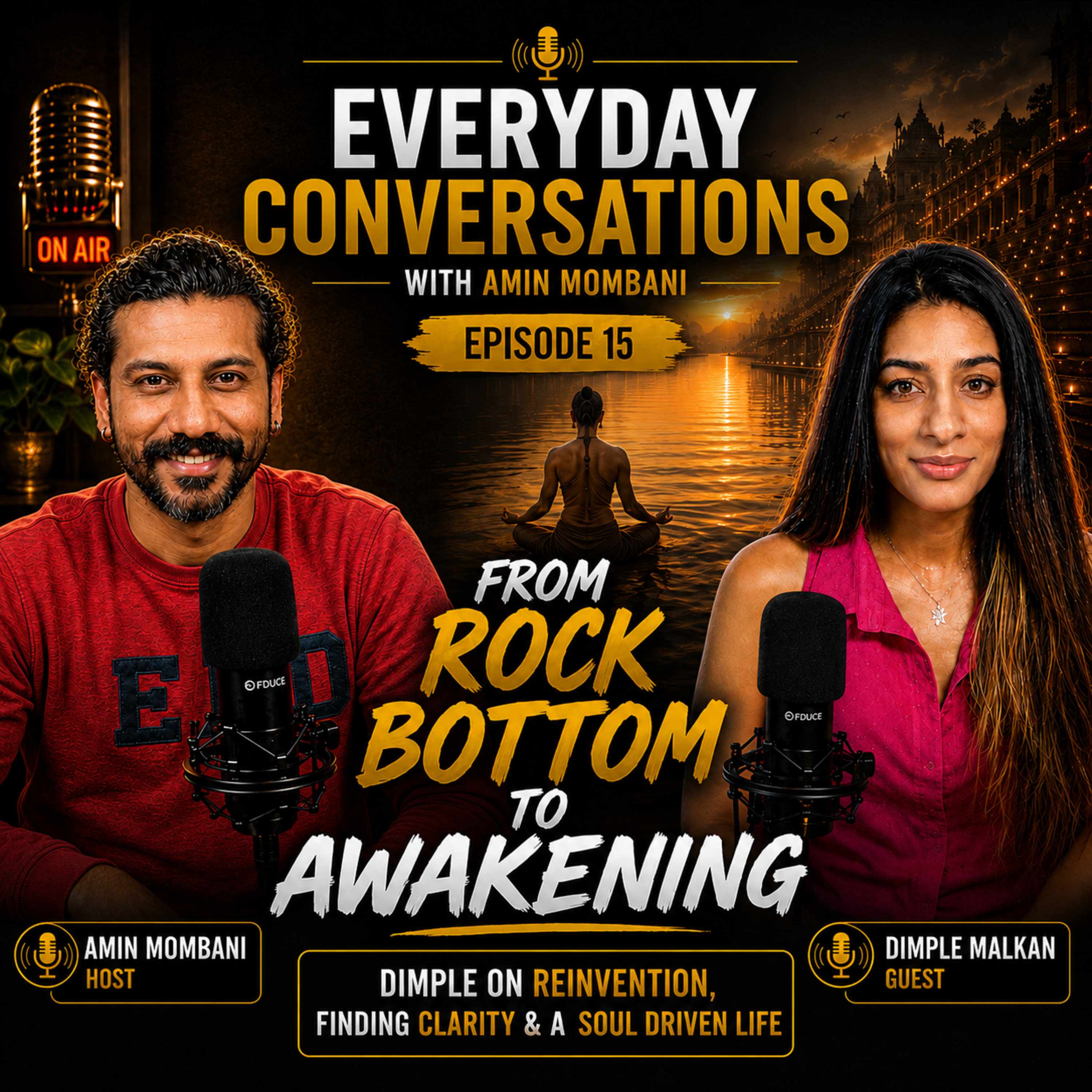
EP.15 - FROM ROCK BOTTOM TO AWAKENING — Dimple on Reinvention, Finding Clarity & a Soul-Driven Life
She hit rock bottom at 31 with a career that looked perfect on paper. Fourteen months in India later, she came home a different person.
Dimple Malkan is a hypnotherapist, yoga teacher, and founderof OmiLomi. In this conversation: reinvention, two Vipassana retreats, an ayahuasca experience, and why she believes success is when you stop caring about it.
Follow the show so you never miss an episode. New conversations every Sunday and Wednesday.
---------------------------------
Contact Details for Dimple Malkan:
Instagram: @dimplisms
Retreat: East Meets West, Nov 20-22 2026, Coldspring, TX
Email: [email protected]
Contact Details for Amin Mombani — Host:
Email: [email protected]
Website: https://aminmombani.podview.com
YouTube: https://www.youtube.com/channel/UCIoXPESGBAlhpbeWg_E7Hrw
Spotify: https://open.spotify.com/show/033CGyVtUGh2KFJ0MJypEZ
Apple Podcast: https://podcasts.apple.com/us/podcast/everyday-conversations-with-amin-mombani/id6782858287
CastBox: https://castbox.fm/channel/id7284639?country=us
LinkedIn: https://www.linkedin.com/in/amin-mombani-29979721/
#EverydayConversations #AminMombani #midlifeawakening #hypnotherapy #reinvention
As the first act of my life, you operate with ego. It's very performative. You're trying to be part of something and you want to immerse yourself in that. But in order to immerse yourself, you also have to be it. Midlife crisis is when you start asking all the questions, What am I doing? Where am I at in life? Have I reached this point? What else do I need to accomplish? For me, I was able to turn my midlife crisis into my midlife awakening, and now I called this act the second act.
Hello and welcome back to Everyday Conversations and I'm a host, Amin Mumbani. Before we start, if you haven't subscribed on YouTube, Spotify, Apple Podcast or wherever you're listening right now, do that because the line up coming up is some of the strongest this show has ever had. Today's guest describes her entire life's work in one sentence. She simplifies the stuff we tend to make complicated Healing, spirituality, subconscious patterns, ancient teachings. She takes all the jargon, all the woo, and turns it into a language people can actually see.
And she doesn't teach it from a textbook, she teaches it from having lived it. At 31, she hit rock bottom, A failed relationship, a carrier that looks successful on paper, and a feeling that she would somehow accomplish nothing at all. That started over a decade of questioning everything, which eventually took her to India for 14 months and flipped her entire understanding of herself upside down. She came home at 42 with no real plan and in just over a year become a hypnotherapist, started teaching yoga, added Reiki and EFT to her toolkit and hosted her first retweet.
She's founder and creator of Omilomi. I think we have to speak her about that. What exactly is this? A facilitator, hypnotherapist and the mind behind what she calls dimpleisms. Interesting name and I wanted to ask her about this as well. So let's welcome Dimple. Welcome to Everyday Conversations. Hi. I mean, thank you so much for having me. Super excited to connect and share all that's dimpalisms. So what exactly is dimpalisms? Before I go anywhere further, I want to ask what exactly is dimpalism?
Why the name? So to put it very plainly, dimpalism is simply my perspective. That's, that's all it is. You know, like I always like to say, this is a dimpalism. It is only my perspective. And the way the name came about was actually when I was in medical sales before my manager. Beautiful soul, great guy. And every time we were, you know, I was in a ride along with him or we were just together, I would say something and he would just shake his head and say, OK, that's another dimple ISM. I've never heard that before.
It's a dimple ISM. And so he's the one who coined that. And so then two years later when I was thinking of I have all these perspectives and their mind are uniquely mine. And it just came back up and I said, Oh my God, Fernando had given me this amazing name, Temple ISM. And so that's where it came from, and it's stuck and it fits. So what I little bit know about you is that people, most people who know you, it's because of your energy, right? Yes, I like to say that my superpower is my energy and my voice, and I like to.
Bring together. So let's bring your light, your energy, your curiosity, and your laughter into this show. Let's do it Perfect. So how was your day today? How was everything? It is pretty good. Today is starting. It is 10:17 AM over here. So there's a lot to do today. There's a lot left in the day to do so either I thank. You so much for giving me. Thank you so much for giving me a very morning early slot for the episode. No, of course, thank you for having me. You've been great. Thank you so Dimple for the listeners.
First thing, let me know what did the life actually look like right before you hit rock bottom at 31 like the version of you that looks successful on the paper? That's a really good question. I don't get that asked enough. And you know, it's interesting that you asked me that because I actually did some deep diving about two months ago and I was trying to remember that 30 year old dimple, that 31 year old dimple. And it was important for me to go back and meet her. You know, everyone wants to always meet the healed version of themselves, the best version of themselves.
And for me to understand how to even how I got to that point, I needed to meet her again. So at the, I will say 30 at 30, you know, I thought that I had it figured out and figuring out really honestly meant I knew who I was going to marry because in my 20s, that's what everything was. I wanted to travel and live life, do this and all you hear, especially in South Asian cultures and parents and community is get married, then travel, get married, then do this, get married and then do this. Essentially, it's live your life after you get married.
So that's what I strived for. It's what I aimed for. But but there was a part of me that never really resonated with it. So I think when that last relationship, it hit, it was I thought that I was where I needed to be. I thought that I had finally reached it. I had gotten, I finished my master's, I had stepped into the corporate role in the corporate world and I had this stable relationship. And it just finally seemed as though everything was aligning the way it was supposed to. And then all of a sudden everything blew apart.
And yeah, so right before that hit, I hit that rock bottom. I thought that I was at the very top. I think that's the only way you hit rock bottom right is when you're at the as when you think you're at the top and.
Perfect so walk me through the actual decision that you go to India for 14 months. What did you think where you were like leaving behind everything and.
So I wish I could say it was an actual decision. It was definitely not a conscious choice. I lost my job and three days later I was in India and I was. I hadn't been since 2015, my parents hadn't been since 2012. My cousin of mine was getting married and my mom lost two siblings in Bombay during COVID. So I was we were going back and forth for about 6 to 8 months. Are are you going to India? Are you not more them than me? Because I had my job. So finally about two weeks before the wedding, I asked my parents.
I said are you going? Do you want to go? Because if you want to go, I need to book your flight now. She finally decided yes and I booked their flight. And I just had a strong feeling that this job is no longer going to be part of my existence anymore. It was just a matter of when. And then it just so happened I lost my job. I call, I remember calling my dad and saying, OK, I'm done. I said my dad said, what are you going to do? And I said, I think I'll go to India. I'll come with you guys. Three days later I was there.
I arrived there on the day of the first function at the end of January. The plan was only supposed to stay for two months. I had a job and everything lined up for after. I should have been back in April with my parents, but it was no longer my plan and I ended up staying for an additional 12 more months. So, so OK, so you came back in April 2020. 5 again. So what was the very first thing you did when you got back home? But like, I know there was no real plan, nothing. But what was the very first thing?
Wow. I think when I first got home, integration and integration wasn't easy. You know, as soon as I got back, I, I walked into something really heavy as soon as I got back, my parents anniversary is April 2nd. So the goal was I have to be back by April 1st and surprise them. So they didn't know I was going to come back. And then we had a massive tragedy that occurred just in our social circle. So it was getting thrown into a lot of heaviness. And after being away for over a year, it was kind of like a deep dive back into, OK, you're back into this world, but you're no longer that same person.
A close friend, she gave me a challenge. And in that time, and she said detached for three weeks. So after my birthday, my birthday's in April. So celebrated my birthday here. And then immediately, a week after, my friend gave me this advice and I said, yeah, it was detached. So for three weeks I stepped away from everything again, but this time it was while I was here and I stepped away from my phone. I didn't listen to any music unless it was frequencies. Even when I was at the gym, I had frequencies, no TV, no books.
And that three weeks, that was three weeks of just stepping away from everything while being here. That really helped me with that integration. It helped me purge a lot. It helped me do a lot of understanding while I was in the surrounding that I basically grew up in. But then it was what am I doing with my life? I can't go back to what I used to do. So what's next? And I heard of hypnotherapy. I heard of hypnotherapy right before I left India and like a week before I left. And then I heard about it the week I got back.
And I don't believe in coincidences. So I immediately said OK, maybe hypnotherapy is the way to go. I have no idea what this is, but it looks like I'm being guided towards it. And I researched, I saw the first program I did not do, I didn't compare schools or anything. When I came across that first program, I set up an appointment and immediately we spoke and all the signs were there and it just seemed as Doug, this is the alignment that I was looking for. I had a lot of questions when I first got back and it was, what are you going to do now?
Are you like a spiritual guru? And anytime someone asked me, I would just laugh and say, look at me, do I look like a spiritual guru? No, but I think I got promoted to like assistant manager level, you know, to where I can help people, meet them where they are just based off of my own experience. I mean, everyone's journey is extremely different. The players are different, the situations are different, but the emotional turmoil that we feel in these situations, the survival mode that we live in that is similar.
I don't need to be in your shoes in order to empathize. So knowing that part, understanding that part told me that, well, I think I'm stepping into this niche and it's helping people, but I wasn't sure necessarily how to do that. I was like, do I want to be a life coach? Not really. That doesn't really work for me either. And then So what hypnotherapy fell into my lap. It just made all the sense. And then it seemed as though when I got, when I started the program, I started the program in June of last year, So 2025 when I started the program, honestly, it just felt like I was able to put language to everything that I had experienced in about the 1213 years before.
And then India basically allowed me to embody. So it's like things for me have been reverse engineered. I went through the experience, I went through the hardships of understanding what healing looks like. And then I got the language on the spiritual side while I was in India. And then I came back and I started this program and it was OK, here you go. Now here is the actual language that everything that you did, you can now share it with others in a way that makes sense to them with a little twist of a dimple ISM over there too.
Definitely. It's a very good thing. So your whole brand is built on simplifying the woo and cutting the cutting through the jargon. It's how I've understood it, so why not? But you but you have start. But you have start Hypnotherapy, yoga, Reiki and EFT all together. I what would you say all together necessarily? I did my yoga training in Rishikesh in 20/25/2024 and but to be really honest, I didn't go to yoga school with the intention of becoming a teacher. I didn't know what I was doing. I just had to start somewhere, you know, staying in India.
And it was what are you doing here? And it was I used to start somewhere. I keep hearing you need to surrender. And every time I heard you need to surrender, all I kept saying is, do I look like Julia Roberts? And you pray, love. I have no idea what surrendering means. And no one exactly explains. You know, you hear all these words. You hear surrendering. You hear trust the process. You hear. Don't identify what the ego. You know, when you hear these words and you sit here and you try to understand what these phrases and what these words mean, it's like a completely different language.
And in yoga school, when I got there, my yogic philosophy teacher, he's actually the one who really helped me. So it wasn't the asanas, it wasn't learning any of that, to be really honest. It was my yogic philosophy teacher. He cerebrally helped me understand a lot. Like he really, really broke it down for me. He simplified it. He talked in a very simple language and that is what inspired me. And there are times even now when I think about his teachings and I'm like, oh, that's what Krishna meant.
I might not have understood everything at that time, but I told myself, be a sponge. Forget everything that you know, Forget all of your experiences. If you're going to do this, then you have to be a sponge. You have to let go of everything and just open mind. And that's what I did. And I think, I think I started surrendering probably the last day of my yoga class, of yoga school. I think that very last day is when I finally cried and like, really just allowed myself to be vulnerable. And then from there, the journey just took off on its own.
And then I just said, OK, where am I going next? And my feet would just say, we're going here, We're going here. And I just kind of went along with wherever my feet wanted to take me. And yoga from Rishikesh is something people dream of doing it. I yes, I I learned that after. Really. Because in, you know, the way is right now being a top most fit city. Actually they do a lot of fitness events for month of month, two months, three months. So there are many yogis over here, many yoga teachers and mostly the Europeans and Russians.
They have been to Rishikesh to just complete their yoga hours, yes. We actually had a group of Russians that ran our program. So after so like from 2015 you haven't been to India and then you went India, how was your feelings over there like did you adjusted your lifestyle or because you didn't knew that when are you going to come back right? No, I had no idea. I mean, I had to adjust my lifestyle. It was very interesting because I do I, I love travelling and in 2023 my resolution was actually one trip a month, so.
But travelling, but travelling and something, something. Like India was different, yes, but but I. Even even India, if you even India, if you go, if you go like OK, you went to any city in India or any province over there for a couple of days or for a week, that's fine. But fourteen months, India, that was something which was out-of-the-box. Beyond But what I was saying is that when you are someone who is open to experiences, which is what my journey has been with my travels, it you learn a lot.
You learn about how you want to travel. You learn about how it is that you want to experience other cultures and other people, and a big part of that is your ability to adapt. So for me, when I got to I1, my family is in Bombay, so Bombay is based. So Bombay is really no different than any other, any other big city. But I've never had my own friends, excuse me, in Bombay. So it was, it's lonely in that regard. You know, you have family there, but nobody else. However, when I started my journey and I stepped outside of the comfort of the bubble, it was amazing.
I yes, things gradually started changing. So like the first when I took my parents to Jaipur, you know, just accommodations alone, right? My parents, my dad's like, yeah, let's stay in these nice hotels. And so it was like, yes, of course, you know, we're going to stay in comfortable, nice hotels. And then my cousin from Dubai, she came to meet me and we went to Goa. And at that point, we stayed at the West and then my other friend from California, when she came, we stayed at J Dub, you know, so we, it was you kind of you're traveling, you're enjoying, but you're also you're staying comfortable, right?
So it wasn't great mix and match going on. Well, it started, but then by the time when the journey took a life of its own. Now I'm staying in the room court and I'm like, my rooms are ₹800 a night, you know? Like, yeah, there was a a gradual transition and comfort started to mean something different. Luxury started to mean something different, necessity started to mean something different. So that transition was very interesting. It was more about the overall experience. It started becoming more about conscious spending, you know, opposed to just frivolous spending.
So you start to understand what people mean when they say conscious eating and conscious spending and conscious living. So it was embodying all of that. But I never felt alone. So I for seven weeks when I was in the Himalayas, my travel companion was a 70 year old white man from New York who retired and lives in Rishikesh. And his name is Paul. And he played a massive role when so wasn't, I was never alone. And so my parents here, they were super comfortable and happy because they're like, oh good, she has somebody.
And and so, yeah, Paul was my travel companion. Rishikesh. I had an entire school full of friends and then I truly was alone. I was in, I was alone in Manali for about 3 weeks. But even then, where I stayed, I stayed at Drifters Inn and beautiful location over there. They really made me feel welcomed. And so I would just spend time there and there's other travelers and you kind of just get to know everyone. You know, when I'm really starting to kind of not really step into my role or my purpose, but just talking to individuals, I'm able to see different reflections.
And that's. And then I ended up meeting Paul. And so then Paul joined me on my journey. And then when I, we went to Layla doc as well. And from there, I, my firm, my, I was truly alone when I went to Sikkim and I did my first Vipassana and Sikkim. And so that pretty much closed up my four months in the Himalayas. And then I said, OK, I think I would like to go back to Bombay now. A little bit of home, a little bit of comfort would be nice, you know, after traveling so much. So I went back to the concrete jungle and but you know, I didn't really get that.
I didn't get that safe space feeling. You know, as soon as I got back to Bombay, it was almost as though, OK, you've spent the four months in connectivity, understanding and learning. Now it's time to put it into practice. And it was immediately, it's like I got thrown right into it. And even with my family there, you know, would then I was there for maybe about 10 days, maybe 2 weeks. And it was, we don't want you staying here anymore. You need to stay somewhere else. And it was just. Dealing with all of these obstacles that I was not expecting.
And so then it just really came down to how am I going to respond to this? And you know, but it was thank you. You let me stay for as long as you did You, you kept my luggage here. I appreciate this. We don't need to make this into a big family discussion. But I also understood that when someone wants to set their boundary, they have a hard time just saying, hey, is it OK? Can you leave now? And that's that's really all they need to say. You know, it's their home and I respect it. And but people have such a hard time just laying out their boundaries.
So they'd rather create a situation, you know, where you're creating this energy of animosity and toxicity. There's a tacky because they want to feel justified and them saying you need to leave. And so I had to stop my aunt and I said you're allowed to tell me you need to leave and you can do that without attacking me. So now it was starting to use my voice in with my family in India. And you know, it is a very patriarchal society over there. And so the adults, the males, it was me having to say, I understand, I understand you think you're protecting me and I respect it.
I also don't have to listen to you, and it was being able to use my voice and saying all of that, so that part was fine. That's what that's what my whole question was about that adjusting the lifestyle because you're born and brought up like brought in ringing up over there in US and then since 2015 you haven't been to India. So the most changing in the culture is like every day there's something changing over there in our South Asian countries. I don't think I really had an like adjusting was not a problem for me.
I'm I like, I'm that individual. I'm like a chameleon. You know, I like to I like to think that wherever I go, I adapt the situation. So even in that of what we're saying that the guest house over there and it was a beautiful Punjabi family that owned this guest house and, you know, I would just treat them like they're my own family. And so the auntie, you know, she was everyday she's like, are you OK? And I'm like, Auntie, you know, and I'm talking to her and I bring her mangoes and I'm like, auntie, I want mangoes.
And she's like, do you know how to cut mangoes? And I'm like, no. And then she's just getting mad at me. She's like, come in, come in the house, sit here with a dish and a knife and she goes here and learn how to cut. And I'm like, OK, OK, right. And she's joking around with me and I got to practice my Hindi. So that was fun. But then and then she had a head, you know, when she had headaches, I would come and I'm like, Auntie let me massage your head and she's like, OK, that was massage your head for her, you know.
So wherever I went, I, I fully immersed myself, you know, I didn't, I like to say that I make myself at home everywhere I go, so. I just coming back to this, I was just coming back to this that I wanted to ask you how is your Hindi and when you went to India, did you practice Hindi or did you learn some Hindi or you are already well versed in that? My Hindi's pretty, it's pretty decent. I haven't spoken obviously a while now I'm, I speak Gujarati at home. I actually learned Gujarati before I even learned English because my mom.
So I learned English in school, but I picked up Hindi with the Bollywood movies. So when I was in India, yeah, it was, it was actually really helpful because I, I did, I was speaking in Hindi a lot and they, they love it because it's with the accent. So they're like, oh, you're Hindi so cute. And I'm like, take advantage of that. But yeah, so I think that adapting, I feel as though maybe it was the other way around. If anything, I think that people in India were probably having a harder time adapting to me adapting.
I think that there's a certain stigma that's associated with a girl who's born and raised in America, and she's here, and there is a certain stigma, there is a certain bias that is there. And when you don't meet that expectation, those individuals in front of you don't necessarily know how to respond. And I can choose, and I could fight it. I could sit here and try to explain myself over and over again. But instead I just said, you know what, I if this is good, this is OK. We're sometimes you're just not compatible.
You know, in that time, in that place, in that situation and everything happens for a reason. And my family doing that, they pushed me out of my comfort zone, you know, because I had to figure out what I was going to do, where I was going to stay. I had to understand the difference between where I was affected and responding out of ego and what is self respect. You know, I had to practice discernment without even knowing what discernment was. And that's when I got taken. And then, so then I spent a month in Goa and I said, OK, well, I don't want to stay in Bombay and pay Bombay prices for just one room.
Instead let me go to Goa because now it's also about conscious spending. So then it was I could take this and go to a yoga school in Goa. And that's what I did. And so I had never like I hadn't experienced Goa yet. So I went to Goa and I was under the protection of a yoga school for 300 hours. But I'll be very honest, I did not do 300 hours. I just needed the protection of a school and a comfortable guest house, you know, because you also have to operate with awareness being a female. And over there, I met another friend and he was from Bombay.
And that he, our friendship, like it was so beautifully aligned that I would say the next six months of my journey in India happened because of him and he joined me. And because of him, I was able to go to Mahkum and I was able to get to the South. And I did, you know, but it was him and him and his beautiful family. They live in Thailand and his beautiful wife and his child and his parents. I mean, they opened up their home to me. Another friend that I met in Beremcord, we spent 12 hours together with a few of us and he had missed his flight or his flight was cancelled due to monsoon season and he just happened to connect with us and we spent that day together.
The next thing you know, I'm staying at his place in Mud Island for three weeks and he brought me into his world. It's all about the connections and the energy. When you're vibing with someone superpower and when you're vibing with someone, you feel that the energy in them and I think so that is the connection which you are making everywhere. Absolutely. And that is what you are known for. That's what you are known for. I and it was, it was great and I got to so, but now I have a soul tribe in Bombay, you know where initially I was very lonely, like 6 months, it was lonely in Bombay.
I didn't have anybody. All this now I have so many friends, you know, I have friends all over in different parts of India. And more than that, I have friends that I met who were also travellers who have a special place, you know, and they love India. And we are still in contact and we're still talking and actually spoke to a friend just the other day. So I got to build a lot of connections. And so to me, it's, I'm very grateful I was given this opportunity. I was given this experience 2 days ago.
I figured out the wording for it. I feel, I feel as though I was put into the Hogwarts of spiritual school. I was taken out of my element here and just kind of dropped in India and was like, OK, now here's one year in India. Here's your programming, here's your training. Go. And that's what I did and I was in school for a year. But with everything that I learned with the connections that I've made with the people and the insights that I've received, I think that the best thing that I can do with all that is pay it forward.
And I guess being a religious follower of spirituality, faith and universe, it provides you a lot of guidance and a lot of science everywhere. If you know to look for it if you're open. If you know how to accept. It that's the thing, if you're open to receiving it, I think that's the thing. So going back to your previous thing, your work, so you said that you were not becoming someone new. You are finally getting back to you. So what does that actually mean? So. This revelation hit actually over the weekend.
You know, you think about the best version of yourself. And for me, I would say that I hit that point in 2023 where I, you know, I stepped into my 40s. I turned 40 in 2023 and it was it was almost like everything kind of got tested again. I right before I turned 40, I was briefly dating a guy and it was almost like everything was a test, you know, before red flags. And we tend to ignore red flags or we tend to compromise with the red flags because red what are the obvious red flags? Abuse, verbal abuse, emotional abuse, right?
Cheating, trust issues. Those are the obvious red flags. But then there's other things, right? Communication, accountability, how they react to situations those and depending on all of that, that can be a red flag, right? But because they're not obvious ones, we choose to ignore it because we're so busy focused on the potential of what something can be. So I, when I got put in that situation and I have actively stayed single for a very long time and I feel as though it was just a bunch of tests.
So as soon as I got in that situation, two months and I'm just paying attention and noticing and I'm like, OK, here are these red flags. They're not obvious, but they are red flags. So I need to just act accordingly. And I stepped away without any qualms. You know, there was no animosity. And it's like, I like to say that I just started my 40s that way. And then I got braces again in my 40s. And I will tell you, braces when you're a kid is very different than when braces and you're an adult. But I think getting into getting my braces, I went in for a console and then I came out with braces.
And I realize now that I just stopped caring about the physical appearance or a lot of times people have a hard time getting braces. And this is at least just my journey that there's somewhere subconsciously where you're like, I don't want to deal with this. I'm going to look a certain way. I'm going to be metal mouth for a year, but you know, so those little things are starting to slip away. And I was where I my peak from a fitness standpoint. And so from my work standpoint, you know, everything was aligned and then I get called to India.
So now I understand that I wasn't, I didn't hit the best version of myself because I hit those peaks. I hit the best version of myself because even though I hit those peaks, I actually didn't care about it. You know, it was OK, you're working out you're but it was, I was pushing myself to my physical limit. I got called to Peru June 2023. So I had my first ayahuasca experience in July 2023. But even Peru for me, I planned it without the intention of ayahuasca. If anything, I said I'm not doing ayahuasca, but I planned this very physically exerting trip where I had my first trek.
I did a trek for two days. I'd never done that before. I stayed on the side of the mountain and Sacred Valley. Those little pods, I don't know if you've seen them. So you have to climb 1200 feet, You go, you rock climb 1200 feet to get into the pod. And I've never experienced any of this. So it was almost like that trip was OK, mentally, you've accomplished this. Now physically, can you accomplish this? Which means can you physically detach from the uncomfortableness of what your body goes through?
And then can you recognize when enough is enough? And I feel as though just doing all of that is when Aya called me and I experienced ayahuasca, and that was not fun. And then I think a lot of ships started happening immediately after the ayahuasca. I lost the desire for meat and alcohol. I just started making my boundaries tighter. I really started questioning the dynamic within my own family. And then six months later I ended up in India. So now I understand that all of that happened. My best version was when I detached.
I know it's like a long winded answer but just had the download. I think Vipassana, Vipassana played a very big Vipassana played a very big role in this, I guess. Well, Vibashana happened the year after, so which? Happened the year after. This was 2023, so 2023 is when I went to Peru and then I got to India January of 2024. I did my first Vibashana August 2024 and then my second Vibashana November 2024. Does that help you out? Absolutely. The first vibashana that I had, it was it was really tough.
Those first five days I did not sleep. I might, it's, it's, I like to say it's boot camp for your brain. You are purging, you're purging your mind. And when you think about how our brain operates, you know, we, we work with 10%, less than 10% depending on which report or which book you're reading. But we operate with that small percentage of our conscious mind. So from early days, there's so much that we've experienced, but we distract ourselves so much. I don't know if you've ever played that little game with yourself when you're thinking of something and then ten thoughts later, you're like, wait, how did I get to this thought?
And you try to trace it back. But we do that a lot because there's something that we don't like. And then we're so let's say I wake up and I'm like, oh, I have this podcast stress. Oh no, I have to go do this too. Stress. And we just, we'd keep distracting our thoughts. But the truth is, is we still stay, we still stay on that frequency. So if we're thinking of something stressful, even though we distract ourselves, we still distract ourselves with something stressful and we don't allow our thoughts to completely.
We don't think them full out. So Vipashna, you don't have a choice. It is like you giving your brain that hamster full reign to just run and do its thing. And even if you say, OK, I don't want to think about it anymore, you just don't have a choice. Your brain is saying freedom, let's go. And all these thoughts that I had, maybe experiences, the situations that I had gone through for the last 2530 years, I'm going back and I'm thinking of this or I'm thinking of this individual or that person. And I was telling myself, why am I thinking of you?
I haven't thought about you in 20 years. I don't even care. Why are you in my head? I did not fly to Sikkim for this, but it's because I only viewed that situation at that time from my perspective in this, you know, from a singular lens. And Vibhashana gives you that freedom to really think about it from all different sides. So a lot of thoughts the first time, by day 7, I had a very interesting experience. I was sitting in meditation and I thought of a friend of mine. She's a childhood friend and we hadn't spoken in over a decade.
We just kind of went in different paths. But I don't think of my childhood without thinking of her. So I thought of her day 7 and I was very, I was tempted to ask for my phone, that's how strong of a feeling it was. But then I had to calm myself down and I said, Dimple, you've been having crazy thoughts all week. Let it go. Anyways, about 3 days later after I was done with the course, I was talking to my brother. He had Facetimed me and he said, Dimple, I didn't want to tell you why you were there, but a couple of days ago your friend passed away.
And I just remember looking at him and I was like, my face was like contemplative, you know? And I was like, huh, interesting. And he's like, why don't you look surprised? And I was like, because this. And now I understand what happened. Like I was like, did she pass away three days ago? And he goes, yeah. And I'm like, OK, well, then that's what it was. That's. I felt her. And you also learned and you gained such a different understanding and perspective of life and death that when he told me to me it was OK.
Well, she was suffering. And I'm glad that she's not anymore, but that was a very profound experience. My second Bipashana, that one was a lot better. I was able to sit. The first one, it was hard sitting. I was getting up all the time. The second one, you don't realize it, but you are. You get more comfortable with being able to sit for the full hour. And that one was great. I just felt like I was a comedian. I think for two days I was just laughing in my head. I was trying really hard not to laugh.
The thoughts are just hilarious. But in that one, I did uncover childhood wounds, and I kept hearing that I have childhood wounds. I wasn't sure what they were. And then I uncovered that in that second Vibhasana, and I was able to release and let that go. So they each have different experiences. I tell everyone they should go do it. I guess lots of experience you have felt in India, mostly just in 14 months actually. Yeah, it was like I said, I'm grateful that I got that. I got to live it. So your old career looked successful on paper but felt like nothing.
Now you're building something that looks. Yeah, now you're building something that looks unconventional on paper. That's hypnotherapist, retweet, host, but feels like everything. What actually changed in how you define the success? I think success is when you stop caring about it. I think that's the big deal, right? It's I, I feel as though everything that I was doing before I, I like to say that before India was my first act. That was the first act of my life. It's you operate with ego. It's very performative.
You're trying to, you're trying to be part of something and you want to, you are, you want to immerse yourself in that, but you, in order to immerse yourself, you also have to be it. So it's very performative. I say India's my intermission. Intermission for me was also when you were entering into your midlife, right? So midlife crisis is when you start asking all the questions. What am I doing? Where am I at in life? Have I reached this point? What else do I need to accomplish? For me, I was able to turn my midlife crisis into a midlife awakening.
And now I called this act the second act of my life, which is soul driven. I operate with awareness. But everything that I did in the first act, I love planning. I've always been a planner. I've I've always planned events. I have always been the trip planner. It that's always been me. And I kept hearing again and again, Dimple, you should do this as a career. Why aren't you putting trips together and being a travel Blogger? But I just never wanted to. I always enjoyed doing it for myself, for myself, for my friends, for my family.
It was very personal. And it seems as though now I'm very easily and naturally stepping into the role of a facilitator because I've always been doing it, but now I'm doing it with intention. So the performative side, I mean, being in medical sales, being in sales for 20 years and being in America, it's allowing me to be able to be that bridge between the East and the West. Because I have spent my life, you know, speaking with C-Suite, speaking with corporations, you know, working with doctors. And so I've interacted with a myriad of different personalities.
And so a big part, but before it's you get affected if something doesn't work your way. And now it's OK, I now I have a bunch of tools. So that's how I kind of merge it together. But I want to say success is honestly defined by just saying that these are all the tools that I have to get me to what I need to do. But the outcome, I can't control the outcome. And that, to me, is success. Your whole philosophy is, what if we looked at it this way instead? So is there a belief about yourself you're still in the process of looking at differently?
All the time, every day, you know, I, there's that yesterday, this understanding hit when, you know, when you hear step into somebody else's shoes, you know, look at it from their perspective. So if there's some situation and you're maybe having a discussion, it's look at it from their perspective, right. I realized yesterday that there's all these teachings that we get, you know, and they're meant to be positive and they're meant to be mindful, but the truth is, is they're not because and I, and I think that is what I have stopped doing differently.
I have stopped trying to step into somebody else's perspective. You know, I, I will only speak my truth and my clarity and then I cannot worry about how the person opposite of me is going to react to that. But if I try to step into it, into their shoes, then the truth is I can't step into anybody's shoes. I don't have the upbringing. I don't have their conditioning. I don't know what they've gone through in their life. I don't know how and why they make the decisions that they make. So when you hear step into somebody else's shoes, all you're really doing is you're attaching your bias towards them, but you are making yourself feel like you're being the bigger person by stepping into their shoes.
But out you are only trying to step into their shoes because you want your bias and you want to expect a certain response or reaction out of them according to your bias. And so you. Adding yourself. So when you're having sessions, what does it actually feel like in your own body? The moment when someone in the session finally let go of something they have carried for years. It's amazing. Like I it, there's this release and for me and my body, like when I'm talking to them, I get very like sometimes my face is like right all up in the camera.
It's like I want to jump into the screen and get to them, but I feel it. I feel it in my hands. I feel it in my energy. I allow my Rachio energy to flow while I'm in sessions. And the truth is, is I'm talking, but all I can really do is be in tune with them. But when they have that release, you are able to sense it. There's like this visible relaxation that you're able to see on their face. And then when they come out of the session, you know, I give them their time. And I'm like, take your time.
And it's OK if they don't share what they experience. But 9 out of 10 times I have heard oh I just feel so relaxed like I don't even remember much. I just feel so relaxed and that to me is good enough honestly. No, I want I want to come on your bicycle skill later on. One take away 1 take away. For the listeners listening to this episode, what would you tell them? I would say find the modality or the tool that works for you if you are curious about what the goal is. It is you want to, I said it yesterday, you want to lengthen the pause to shorten the gap.
And it is, if you're able to really understand what that means. But ultimately it is what you need to do to understand that you're going to be in survival mode. We're born with that. You know, the goal is not to get rid of being in survival mode. The goal is not to get rid of the ego. The goal is how do you recognize that that is what you're in right now? How can you take enough of a pause to step out of that so that way you're able to respond with clarity opposed to react on triggers. So that would be the biggest take away.
Dimple, you said you are hilariously uncoordinated on anything by adjacent. A normal bicycle is fine, but a scooty or a spin class where you have to pedal and move your upper body and your body is like your body just forgets how to communicate with itself. You said there are some stories and I'm pretty sure this is the moment where the laughter which you are known for, the energy you are known for, the listener is going to witness. OK, so first of all, bicycles too. I had not ridden a bike in a very, very long time.
And in 2015 when I first started traveling solo, I was in Thailand, in Bangkok. And me and a new friend, we decided to do the bike tour and see Bangkok on bike. And so we got a lot of people together. So they're probably about 20-30 of us. And so we are biking and we're in a single line and we're kind of biking along the canal and there's like a median there, kind of like a guardrail. So we go up a small little incline and the girl in front of me stops. And because she stops, I had to stop, but I was at such a weird angle that I couldn't reach my feet on the ground.
So I'm like doing this little twist churning thing because riding in Bangkok is very stressful, by the way. There's like cats and cars everywhere. So my bike goes over the guardrail and it's like a 20 foot drop into the canal. And so my bike just goes over and I'm but luckily the back tire caught on the back end and I'm just like looking straight down into the water. My bag fell into the water. Luckily they were able to fish it out and I'm just looking and I was like OK, this is not good. And I'm not a strong swimmer actually.
So they had to physically lift the bike up off the guard rail to even get me down and my legs or everything is completely cut up. And my friend who I planned to switch, she was much further back in the line and she's like, what's the hold up? And they're like, somebody fell over and she's like, is it dimple? It must be dimple. It sounds like a dimple thing. So that was the bike experience. That same trip right before that, we were in Vietnam and she decided to rent for scooties and we were at cut by Island as she comes and goes, I rented for scooties.
And so me, her and two other friends that we had made, we're like, OK. And I was like, I haven't driven one before, but yeah, let's do this. And yeah, we did not make it up and out of that resort. Eventually the workers that were there said, please, guys, don't break our bikes. And they just took us around instead. And we just sat passengers and then spin class, yes, spin class when you're doing the moves and it's like you have the music going and I'm really into the music. And then she's like, get up and stand and bike and I'm biking.
And then all of a sudden she goes grab the handlebars and push ups. And I was like, I can't, I can't, I can't do that. So me and two Wheelers, we just don't. I even in India this past time I was really trying. I was like I need to learn how to ride a scooty or something but I don't know. How amazing, how amazing, right? Passenger, a hypno therapist. Hypnotherapy came afterward. But, you know, on biking, you garden like watching a canal. And suddenly a thought coming in the mind that, OK, I don't know, swimming, how can I swim over there?
I was just coming in the mind. Yeah. Oh, yeah. I was just, I was just, no, actually, I will say that about me. I have been in some pretty precarious situations. And I will say that the one thing that I'm really fortunate about is I am usually able to operate with clarity. I have gotten hit by 218 Wheelers. My first, a 2 Wheeler accident was when I was 19 years old. And even then it was you. You're fully aware, you're noticing that there's this truck coming full speed, you know when he's crossing lanes.
And even at that time as a 19 year old, I remember looking in the rearview mirror and I said, OK, this, he's about to hit me. I'm not going to be able to do anything about this. I just need to slow down to reduce impact. So you know, I did and he ran me up the median. So I'm driving with two wheels on the median, 2 wheels on the ground. And even then the whole time I'm like dimple, get your wheels on the ground, you know, get on the ground. And then I freaked out. So it was in the moment. I'm always usually responding with the clarity that I need.
And so that I will say that is one thing that like, oh, like my 2 front teeth, I fell into rock's head first, broke those. But so even when I fell into the rock and my friend, he was, you know, used freaking out and he goes, Oh my God, dimple, like he thought I fell into the ocean because it was those big rocks like right by the ocean. But I had to, I slipped on my flip flops and I just fell head 1st. And he's like, you didn't make a noise, you didn't scream. And I said, because when I was falling in my mind, I remember my thoughts being, this is about to be really bad.
You need to control your fall because you're going head first. You need to control your fault. So that part has always been there in India before everything started, I had a paralysis attack and I was hospitalized and in my in Rajasthan and we had to go to a government hospital, the middle of nowhere, Rajasthan. And even then there was all this clarity at the time. You're freaking out. My parents are freaking out because I can't move. But in my mind, there was this level of peace and it was OK, if this is the plan that you accept, the plan can't fight it, right?
And so there was there's, there's always a calmness and a peace that I keep within me. And I just think that there was a lot of that. There was a lot of noise. And so for me, it was getting past that noise. But the balance part, yeah, the balance part is really weird. I can do balance within, but I can't balance on a bike. You know the spin, the spin classes, if you come to that, if the spin classes are like, I don't know how the instructor does because I have attended a couple of spin classes and like riding spin class was totally fine after a couple of minutes.
Now they're standing and now they're jumping and riding. I was like, is that spin class 4? Sorry, it's not my cup of tea. Normal, normal cycling is fine, but the spin class was like totally out. And yeah, when you said about thank you, when you said about the accidents and all these things, it's totally, I totally agree to you that when you have something peace and calm in your mind and you're not listening to those noises, I think you can overcome the situation. Absolutely. And I think that's probably, it's understanding the noise.
And I think that's the whole thing. It's understanding where the noise is. It's understanding that there is noise outside of us, that external noise that is external validation. Anything outside of us is external validation. It's external noise. And then we have the noise in our mind. So only after you calm the noise outside of you can you focus on the noise that's in your mind. And then once you're able to calm down the noise in your mind, that's the internal validation, then you're able to recognize the noise that you carry in your body.
And so with yoga, that's how I tied this back to yoga because yes, there's that misconception that yoga, how flexible are you? Can you turn into a pretzel? Can you do this and can you do that? And the truth is, is that's not the point of yoga. But we have so much noise that we carry in our body that if you start working on eliminating that noise, on reducing that noise, then you're going to notice that you're actually going to be able to bend more, be more flexible because now you've given your muscles and your body room to breathe as well.
So eliminating that noise, that is the best way that I can tell anyone is what is noise for you. Anything that's outside of you and your thoughts, your conscious thoughts, that's noise and there's just no need for it. I would say that whoever wants to eliminate the noises and learn something from you where they can find you and what's next, you're doing it. They can definitely reach out to me on Instagram or N City where they see me. They can just shoot me a message. But my Instagram handle is at Dimple Isms as I'm in the process of building and launching Omilomi.
Also, if anybody is in the area and they would like to come to my retreat, the next retreat is in November. That one is East meets West. And for that one, we're actually not using spirituality or any of the jargon. We are going to use very basic, simple language, give you tangible tools that you can use in everyday life. Because you know, you hear everything about how to be mindful and you, whenever you think of mindfulness and presentations, you see nature and you see going to the gym or eating healthy.
But you know what, I live in Houston, right? So we don't have mountains and beautiful nature in here. We have a lot of heat. And it's, so it's, you don't need to go to the mountains to be in nature. Just go outside and step on the grass for 5 minutes, right? And it's, let's give you these tools, these tangible tools. And that's what this next retreat is going to be geared towards. And so, and you can pretty much find me anywhere. I'm flittering around. I'll put down your details in the show notes, especially about the weekly, which is in November, about the Omilomi, I know it's not yet launched.
So that's what I told you that the next episode I would be doing with you is will be on the Omilomi to know people. OK. So I would say a woman who hit rock bottom at 31 with a career that looked perfectly on paper and felt like nothing, She spent the next decade not becoming someone new, but finding her way back to who she already was. Dimple, thank you so much for reminding everyone listening right now that the healing doesn't have to be heavy, that it's never too late to become to come home to yourself, and that the most powerful thing you can offer someone else is just a different way of looking at what they already believe.
So eliminate your noises, I'll put down and show us all the details of Dimple how to get in touch with her about her read feed, which is east where E meets W said correct right. That is in November and her upcoming read feed at the details websites, Instagram, our contact details, whatever you can reach her out, I'll put down in the show notes below. I'll see you guys in the next episode of our video conversations. Till then, goodbye. Thank you so much, Dimple. Thank you SO. Much for giving me.
 Apple Podcasts
 Castbox
 Castro
 Goodpods
 Moon FM
 Overcast
 Pocket Casts
 Podbean
 Podcast Addict
 Podcast Republic
 Spotify