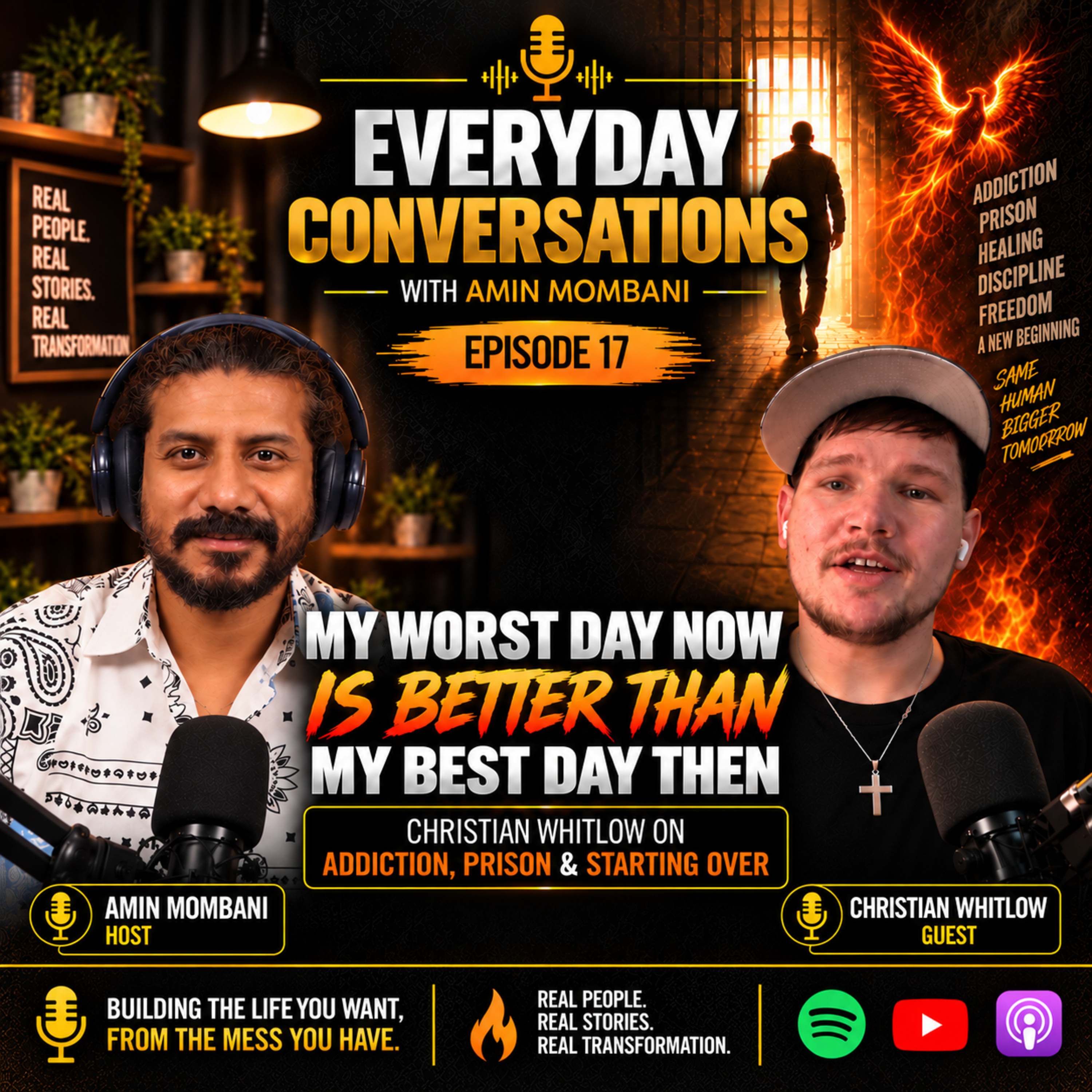
Episode 17: My Worst Day Now Is Better Than My Best Day Then — Christian Whitlow on Addiction, Prison & Starting Over | Everyday Conversations
He was revived from overdose more times than he can count.Today, his worst day is better than his best day ever was back then.
Christian Whitlow is a content creator and podcaster whobuilt Fed By Fire Media to give a voice to people who usually don't have one.
In this conversation: addiction, prison, losing custody of his son, and the small daily choices that actually rebuilt his life.
🎙️ In this episode:
- Growing up surrounded by addiction in his own home, andwhy he says "you're a product of your environment"
- Losing custody of his first son 14 days after graduatinghigh school
- The night in jail that became the actual turning point —not the overdoses, not the arrests
- What prison is really like, day to day, beyond what peopleimagine
- His mother's death, and why he says it's the hardest thinghe's ever gone through
- The one small piece of advice he gives anyone still in ittoday
-----------------------------------------------Contact Details for Christian Whitlow:TikTok: Fed By Fire ForeverYouTube: Fed By Fire MediaAlso searchable as: Christian Whitlow-----------------------------------------------Contact Details for Amin Mombani — Host:Email: [email protected]: https://aminmombani.podview.comSpotify: https://open.spotify.com/show/033CGyVtUGh2KFJ0MJypEZApple Podcast: https://podcasts.apple.com/us/podcast/everyday-conversations-with-amin-mombani/id6782858287CastBox: https://castbox.fm/channel/id7284639?country=usLinkedIn: https://www.linkedin.com/company/mombanipodcast/#EverydayConversations #AminMombani #addictionrecovery #sobrietyjourney #secondchances #FedByFire #ChristianWhitlow #mombanipodcast #aminmombanipodcast #everydayconversationspodcast
Follow the show so you never miss an episode. Newconversations every Sunday and Wednesday.
In 2023, I almost lost my arm to trank and fentanyl, and even that couldn't make me stop. You thought laying in a hospital for a couple weeks would do something. And I left the hospital to continue to still because they weren't giving me enough of what I wanted at the hospital, you know? So yeah. But what I would tell you is something I say all the time. My worst day now is better. My best days in.
Hello and welcome back to another episode of Everyday Conversations, and I'm your host, Amin Mumbani. If you haven't subscribed yet, go do that. New episodes dropping every Sunday and Wednesday. My guest today is a content creator, podcaster, husband and father based in Virginia. But his path was forged through absolute fire. A former drug dealer, criminal, an addict who pulled himself out of the depths of addiction and the prison system entirely on his own. He's simply a human being dedicated to becoming a better person and helping others to do exact same.
In this unscripted conversation, we were driving straight to the real, unfiltered trips about life, crime, prison and family and looking at how a total shift in thinking can change everything. Let's welcome him, Christian. Welcome to Everyday Conversations. Yeah, thank you for having me. I'm, I'm beyond excited about this, this conversation. And I thought maybe I could bring some insight your typical guest doesn't have. That's what Christian, when I saw your intro and the intake form, so I was like, OK, I need to bring this guest in because he has changed his life with just one thinking and definitely he can change the life of many millions of people or even if one person listening to this can change his life, it's very worth it.
Yeah. Just let me know how was your day today? How are you doing today? Well, I'm doing great any day. You know, I'm a, I'm a above ground and with my family it's my day off of work. So, you know, I am always grateful about that. Even though I love my job, I love having a way to provide for my family now, it's still good to have the days off. Perfect, perfect. So before we go dive deep into any of it, just tell me, how would you describe what you actually do now in your own woods? But I think what I do now is I try to inspire other people any way I can on the Internet and in my personal life, you know, and I'll tell anybody, if you want to see the world be a better place, you got to do better yourself 1st.
And that goes as far as you know. You see the guy with a sign on the side of the road, throw him a dollar, you know, and some of my videos they might not get that the I get guess it's kind of got like a motivational speaking flow to it. Those might not get the views as like the body Cam footage and the hip hop stuff. But I still do them hoping that somebody that needs to see it sees it, you know, because I know what it's like to be counted out. And I said another thing I just, I try to do is try to list the people up who feel like they have been forgotten about, who feel like they've been counted out and feel like this is just how it's always going to be for them, you know?
So take me back to before any of this. What did a normal day actually look like when you were dealing? When I was dealing, well, it goes way, way, way further back than that. It goes it back to when I was in them in my childhood, you know, well, you want to know what a day was like and when I was still in addiction, that's what you're asking. All right. So a day in addition, the way it would go is, you know, my whole thing was I lived an hour outside of like the city I live in now. And my whole business strategy would be to go up to the city I live in now, Roanoke, pick up, get something for a lot lower price and then take it back to where I lived where it was worth a lot more.
But the more I sold, the more I used. In 2023, I almost lost my arm to trank and fentanyl and even that couldn't make me stop, you know, You thought laying in a hospital for a couple weeks would do something. And I left the hospital to continue to still because they weren't giving me enough for what I wanted at the hospital, you know? So yeah. But what I would tell you is something I say all the time. My worst day now is better than my best day then.
It's impressive actually. So was there a version of you back then that thought this was just temporary, or did it feel permanent at that time? Oh no. And when we talk about my childhood and everything, I'll get into it. But how other teenagers found football or wrestling, my identity was I always wouldn't to be the street guy. I always wanted to be the one in school that had access to drugs, even when I was only in the 6th or 7th grade. You know that being a criminal and being I guess you can say like just a hooligan or a hood rat was as much as part of my identity.
I saw it as, you know, liking football or something is for somebody else or being unemployment. I thought I was destined to be a criminal and what are, you know, because I got away with so much. And that's just, you're going to grow up, you know, everybody don't care what anybody says. You're a product of your environment, you know, and that's it. That's exactly what I was. And it was just, I lived in kind of a ritzy area where, like, you're either really rich or really poor, you know, so me wanted to be the bad kid and just kind of like, it always put me in a spot where I stood out.
No. So what I'm getting at is, yeah, there was never a point where I was just like, where I was normal. And then one day I decided to get into this. This was what my life was built around from a teenager, from preteen, you know, was people who were doing illegal things and, you know, just living that life.
So did someone notice that or made you change from that place or shift you from that place? Does it have? Yeah, I will tell you, growing up, OK, so you know, for a while, I had a little while finding myself, you know, and I was in a situation where like, you know, my dad, he listens to my videos all the time. And he, my dad was in my life. But, you know, he had rules. He had a bedtime. And my mom was kind of like my best friend. And I'll talk about her later. But yeah, like, my mom is like, my best friend.
Eventually, when I was very, very young, she already would let me, you know, smoke cigarettes and drink and, you know, when I was just 11 or 12. And then eventually it became OK for me to like, you know, start smoking tree and stuff and just moving up. And then I realized, you know, my mom, she was actually like, it was during the time or in around 2010 when we were in like prime part of when in America, they were just giving out pain pills left and right, any but anybody for anything. So I realized that at a certain time of the month, the fridge was full.
A certain time of the month I got new shoes and new clothes, and I eventually learned that was when my mom got her prescription. OK, So what was the moment things actually changed for you? The moment things actually changed was all right. My sister, she was dating a dude when I was like, I was like maybe 10 years old and he had tattoos all over him. And you can tell he, he had wads of money. There would be, he'd have people coming in and out there do tattoo guns buzzing, you know, doing tattoos in living room.
And I liked him because regardless all that, he treated my sister good and he bought them anything they wanted, you know? But eventually he got locked up and all my sister was left with was the addiction. And she eventually brought it to our house and then kind of got my mom. She sold stuff she never liked to you, wasn't really into using, but eventually got into using was my sister. And it got from where like, you know, we had a normal life And my mom just, you know, made money on the side to I'm coming home with like 50, not 50, but maybe 15 or 20 themes I've never seen before.
And there was a time I came home from school and I went in my room and they were, I don't know, I don't want to get you banned or anything or in any trouble, but I'll put it this way lightly. They were manufacturing a substance. And at first I told my mom I was like, I don't want this going on again. I was like, I don't want to be in foster care. I was like, I don't want this going on in our house. And it didn't stop. And then I came home another day and it was like that. And I even told my mom a lie and said, hey, there's detectives at my school that have been pulling me out and talking me and asking me about what's going on here.
And even at that point, that didn't scare him enough to stop or slow down. And that's when I felt defeated. And I was like, I, well, I might as well become part of the gang, you know? So was you part of the gang or the street crime or? Something Yeah. No, I'm saying yes, I was my SO. My sister is 22. All right, now I was 11 or 12. So why? They'd be sitting around smoking blunts and chopping up pills and talking about everything, talking about grown people's stuff. I would be listening to everything they said, not saying nothing.
And then I would go to school the next day and repeat everything, everything I heard them say, you know? But yeah. And just from my early age, I wanted to be around young people and I wanted to be grown. And like I said, I started smoking. And that turned into me eventually starting to sell bud too, you know, And everything just evolved until, you know, I'm 13 and I had, I'm dealing with my own, you know, addiction to real drugs, to opiates and the uppers. So the moment that something changed in your life, that that is place, the real story starts, right?
Yeah, Yeah, I'd say that that moment when I came home and realized that there was nothing I could do about the type of people that was in in that was associating with my mom or in my home, I realized there's nothing I could do about that. So I might as well just basically become as ingrained in the group as I can. And as the years went on, I just eventually became one of them. You know what I mean? When it was time to send somebody to go meet somebody to do a transaction, they sent me. When it was time to go pick up supplies, to put a cook together, I was a juvenile.
They'd send me, you know, and I thought I had this slickness and this toughness because in my area, you know, it's very urban. Not not, I'm not going to say urban, but there's a lot of crappy kids. It's mostly white. So I stuck out like a sore thumb. And in my eyes, I was doing things. And as I got older, you know, I, I realized, you know, I started seeing around me. But you know, I will say this, my father, he worked a good job. He before he had me, he did 8 years in prison and got his life together.
He got his heating and air certificate while he was in prison. And, you know, he I had the idea of what a good man was in front of me the whole time, but I was just surrounded by these like gangster type figures. And I was more intrigued with wanting to be like them when, you know, that was that was that led me the complete wrong way, you know. Sometimes it does influence, which leads us to do the same thing. Yeah, yeah. And it does. So anyway, what eventually ends up happening is I start hanging out with some other kids that are just like me and my school that are a little older and, you know, their family is on drugs.
My family's on drugs. So we just get together and hang out and talk about all that drama and we go and meet people and we'd have Fight Club in the in in the yard. After we do our interview, I'm going to e-mail you some of my old mug shots and stuff and some pictures from like my younger, younger years, I guess. But as time went on, it just became like, my house became the place where all my friends could come over and hang out, you know, because my mom, she was like, I don't want you anywhere getting in trouble, you know?
And it eventually turned out to where my house was the hangout spot. But an issue we had is I can talk about all this going on was we can never keep a house for longer than six months. We ended up in a woman shelter like 4 different times. We could never get settled anywhere because of the riffraff that was going on, you know what I mean? And it's just like anywhere you go to live. We could put on a good front when we went to look at the house, but a couple weeks and the landlords knew what was going on, you know what I'm saying?
But. Listen you, Sir. You go ahead, buddy. Good. OK, so Christian, you got clean and reinvented your whole life after that? No, no, no. All right. I went on to like, I'm talking when I'm, when I was younger, pretty much I go through from 14 until 28. My life is consumed by, you know, dealing by being homeless. And I also had two kids along the way. I lost both of them. And yeah, no, you're good. But I had two kids along the way. I lost both of them. But since I've got clean, I ended up getting my daughter back at least.
But yeah, so I was just giving, giving you the beginning. So basically everything evolved and I have my first son when I'm 17. And there comes a point when, all right, two major things happen. We get raided at my house that's in town and I am selling to this girl and I'm her and her mom have a basement apartment, you know what I mean? And it's in the country. So I moved me and my mom out there thinking it's going to get us away from any type of a law enforcement heat. And once we get out there, I found out that one of my best friends from high school that I, we were on the wrestling team together and everything, he had a war wire on my mom.
And so the feds came and picked her up from that. And then there was also a time were in the same day I had took a bunch of Xanax and tripped out and tried to fight the police and everything. And then later on another girl we were living with actually tripped out and tried to fight the police and they came back and tried to give my mom two different charges for delinquency of a minor. So my mom she had never been in any type of trouble in her life. She's having all these legal problems come to her once and it pretty much send her in a like a downward spiral mentally like, and there comes a time when she she lost my niece because I grew up with my niece, like it was my sister, because my sister had gotten her addiction.
And but anyway, she had lost my niece. She got ticked by social services and my mom just kind of lost it. And at one point the water got caught cut off where we staying. And she told me she was leaving to go take a shower. And then she went and checked herself in a mental hospital hospital and basically told me, you know, you're you're, you're 15, you want to do adult things. It's your chance. You know, you're on your own. And then the girl I was living with, I get it with her sister and that actually ends up becoming the mother of my children and you know, the mother of my first son.
And we get our first trailer when I just turned 17, I had got a Social Security check for being for having ADHD. And also I worked at Taco Bell. So you know, there we are. But at the time, I'm still, we're both still heavily addicted to drugs, you know, me and this girl that I'm having a baby with, you know, and that's actually my wife now. We've been together 13 years. But yeah, but so we're doing drugs and stuff and it made it to work. But we get our first trailer, you know, and I end up getting a job at a restaurant.
But at the time, I'm trying to finish high school, you know, But I'm still addicted to pain pills, really bad and still addicted to ice. And that's just what it was it. But it made it to where when we had the baby, it kind of it was born, you know, she was born with just weed in her system. He was born with something in a system. So it put social services in our life off the bat, you know what I mean? So from the beginning, we were dealing with somebody putting us under a microscope, trying to take our kid away, you know, and but we tried to do as good as we can and hiding it.
And nine months down the road, me and her getting a huge argument, a huge argument. I'm not going to get into a whole lot of specifics, but basically heard my son getting a car wreck and he's took out of our custody and put in foster care and then my cousin had to go to court to get him put in her custody. So, and that was all 14 days after I graduated. So I had did all this, got my own trailer, graduated and then I lose my son and it's like everything I worked for is just like kind of blew up in my face.
But my, my cousin ends up getting my son and now we do get to see him. I, I see, I see him every other Friday. But that's it anyway. That the, the, that, that, that killed me. You know, that was like, cuz I, after everything I had been through, you know, I, I, I thought like, I thought I, I was where I wanted to be. I had proved everyone wrong. But it was looking more and more like we wasn't getting him back and we were going to court trying to get him in some getting in my cousin's custody. And it was just a bad time.
And it kind of brought me and the mother of my kids closer together and she ended up pregnant again. This time with my little girl and this time with her, I was able to get it together enough because after we lost my son, I had kind of let my addiction get the best of me. I lost our trailer, I lost our car. But you know, I kept my job though, and eventually I was able to save up enough to get us a little one bedroom apartment and we had the baby and we had my little girl and she's my wife. She's she's she was clean when she got pregnant with our daughter and clean this go around.
And but she was dealing with a lot of legal issues, like a lot of probation violations and just a lot of stuff catching up with her. So she spent a lot of that time when I first got that apartment incarcerated. And then once we had the baby, there was about 3 months where we're just me and her when she was first born, you know, and I after that, I, I lost my job in that little town we were living in and we moved back in with my mom. And that pretty much put the daughter that I just had in my mom's care.
And that way, once we got to my mom's, my, the mother and my kids, she had to go, she went and did two years. So it was just me and the baby and my mom. And but later on, as time went on, everything went good for a while. I started working at a Detroit style pizzeria and I'm working with the dude. He's like my, he's, he was like a mentor to me, but he gave me some, He told me eventually that he liked to do a little blow here and there. And he gave me some money and I ripped him off and, and he fired me.
So I was just there, you know, I was going from job to job. There was a time I worked on Virginia Tech campus as a custodian and everything was fine. And then eventually I start dealing with some legal issues and I go and do a couple months in jail and my mom loses that apartment and then has to go live in a hotel. And when I get out of jail, I come home to a hotel with just, you know, my mom and my daughter. And being at that hotel kind of put me in a bad way. And at that point, I had been away from the mother of my kids.
And I'm living in a hotel. I'm fresh out of jail. I'm not doing good at all. And I had not done any work on myself, you know, And I was away from the mother of my kids. And the mother of my kids, she kept me in line. She could see all those invisible, invisible boundaries that I could not. So, you know, the way I put it in my book that I'm putting together is I was pretty much like a rabbit with a broken leg, just a beaten up person. And it's like this girl that I met was like a vulture circling around.
And eventually, like I start hanging out with this girl and that's when I start injecting and everything and things just get to the worst. They got, you know, I stopped using it went from for years, you know, from my teenage years, I was addicted to pain pills. And then once I met this other girl, it turned to age and Fetty, Fetty, you know, and you know, it just progressed and that's when it really got into where I don't even need a job anymore. I'm just going to do illegal things and make illegal money because I'm not going to live that long anyway.
I'm a die any day now. Anyway. My daughter's with my mom, my son's gone. The the mother of my kids is, is locked up and I've already done her wrong by getting with this other girl. So what am I living for? And that's pretty much where I was at. Go go ahead, buddy. True, true. I'm saying that's that's very true actually. Yeah. And so pretty much I'm with that girl and we are staying at a with a schizophrenic guy who is pretty much only cool with him when we give him drugs to stay there. And then anytime we don't have the drugs, we're put out on the street.
So I'm pretty much staying there with him. We're doing that for a couple years. He would let us let people come to his house to to see us, you know it. But it was just a chaotic scene 24/7. And I like eventually just become to where that's my life. I mean, don't get me wrong. Even when I was in the depths of my addiction and let me tell you, I was about £100 lighter, I was looking like a skeleton and everything. I would never be messed up or high around my daughter. But I made sure I went and seen her every other day, you know, at my mom's.
But I was with that other girl and we're pretty much like, it's pretty much just when things are good, you know, people are coming around, we're making moves, we're making money. We got money in our pocket. But when we're not doing good, I'm a piece of shit, and it's up to me to break into somewhere, to steal from a store, to figure out how to get us well when we're sick. Like. And I'm not going to bash her too much. I ain't even going to say her name. She don't deserve that respect. But she was a narcissist.
Yeah. And I'm just such like a loving person, Like I like it if I it's just how I am with anybody. To the point where when I've gotten sober, I've had to realize I got to watch who comes around me. Because if I spend enough time with you and I care about you, I will go to the end of the end of the world for you. And that's just, that's just how I'm built, you know? And she was able to really take, take advantage of that. And we're living where we can pretty much anywhere we can keep the people high enough to let us stay.
And then we're living in a shed. And that that was connected to a church. It was a maintenance building for a church. And during COVID nobody had went in there. So we went and put a couch and a futon in there and lived in there for 2 1/2 years without knowing. Knowing. But yeah. So that was pretty much my life. And a lot of sleeping in parking lots, a lot of sleeping in cars, which, you know, when I was homeless as a child, that's nothing new to me. But you got to think, you know, as a person, like, you got to want more than that.
It's just when you're living that life, it's so easy to convince yourself that you don't deserve love. You don't deserve good things, You know what I mean? And that the best way to protect the people you love is to stay away from them.
So what was the year you got clean and reinvented the whole life? OK so my clean date is 12/18/2024. And why did you actually decide to do that on that specific point? OK, so at that time, the girl that I was with that I was told you that I was pretty much running, running with, you know, in the book, I call my my wife hostage #1 and I call her hostage #2 because we were just hostages, you know, to drugs. And yeah, anyway, I'm staying with this at this old man's house. And he's like an old man, you know, he's obviously on drugs too, to let me stay there.
And I tell him that I know where these motorcycles are. And he doesn't ask anything about if they're mine or anything. And he just agrees to help me go get him. And I had already got one of them. I had already rolled one of them to the house and I just need help getting the other two. And I get him to help me. And on the way back, somebody had called it in that they've seen two suspicious people rolling two motorcycles down the street. They stopped us. And I tell him outright lie. I'm like, hey, I know the maintenance man at Virginia Tech and these were abandoned.
Obviously it's a Ducati and a Ninja. No, but there's no days weren't abandoned, you know, but so the cops are like, all right, well, as long as they're not reported stolen, we're going to let you go. And they let us go. But the old band I was with told them where we were staying and they called the Virginia Tech Steve. There was a maintenance man by the name I gave them and there wasn't, and they didn't run my name while we were talking during any of that. So they come to the house to get me for stealing the motorcycles.
They find the motorcycle that I had rolled there before. And once I give them my name, I have two warrants out, one for distribution of a schedule through narcotic and another one for a possession. And this time I go to jail. And it's not like any other time I go to jail, you know what I mean? This time there's no getting out of it. And my lawyer is basically telling me I'm not getting a bond. And even if I do get a bond, I'm, I'm going to do at least 2 1/2 to three years. And eventually, you know, Mama, the mother of my kids, the one I was talking about, she had just got out of sober living.
She was in this thing called an Oxford house. And by the time she was out of it, she had got so high up that she was running other houses, you know, and she had got her own apartment. And I begged her. I begged her. I said she got her an apartment with her mom. And I, I begged her. I said look, I said if you let me come there, like I will change if I get a bond and I just like I was, I remember being in a cell the first couple days in there and just like praying to God and be like God, just take this from me.
Just please take this from me. Like if you can help me help take this from me and give me a chance to change my life. I will not make you sorry. Another thing that happened while I was in there, I'll tell you about is while I was on drugs, I got on methadone. So that way at least when I didn't have the age for the pain pills, I had something to keep me from being sick. So when I got to the jail, they switched me from methadone to Suboxone and that helped me a lot because I feel like a part of the methadone was part of my addiction because I was on 200 milligrams a day and that's it.
Ask anyone that's a lethal amount of methadone and it was pretty much making me a zombie. And then I was using, you know, St. drugs on top of it. So, you know, getting on the Suboxone in the jail held to me. And then eventually when I came home. If you ever hear of anybody struggling with opioid addiction, tell them about the Sublocade shot. It's a once a month injection. It's what I'm on now. And I owe a lot of my success to, you know, it's helped to even the most hardcore junkies that I knew helped get clean, you know, But anyway, I'm in jail and I'm laying there sick for five days and they switched me onto the Suboxone.
And that helps. I'm able to get up out of bed, you know, for and actually get to think about things. And I just decide I'm going to better myself. And this is going to be the last time that this this isn't for me. Like, I, I come, I, I owe my people so much more, you know what I mean? And this is I'm going to tell you about when my mom passed. This is when my mom is still alive, though. And I was like, my mom's bedridden and, you know, she's confined to a bed and she's in her last little bit of life.
And this is how like, I'm choosing to spend my life, you know what I mean? And anyway, like I apply for a job in the kitchen at the jail and that was the first step that got me used to working a 12 hours a day. You know, that kind of conditioned me for a 12 hour work day. So I work in the kitchen and I'm not expecting to get a bond. But eventually my lawyer comes to me and says, well, he tells me, I don't think it's going to happen, but I'll try since you keep calling. And we go and they give me one.
It was a high one. It was a, it was a $10,000 one. So we, they had to put 1000 down. And at that point, you know, I'm, I'm, I'm burnt. Like I don't got no one to call. My dad is basically saying that's the best place for me. You know, my whole family is saying that's the best place for me. But I'm able to talk to her and she bonds me out. And when she bonds me out this time, I say, all right, I'm not going back to where I was living. I'm not. I'm not making a Facebook. I'm not making any type of social media.
I'm just gonna get a little rinky dink job and go from there. And that's what I did. I got a job at Taco Bell and then after that, my wife, she'd been working at a cigarette warehouse for four years and she didn't want me to get on there because she thought I would ruin it for I'd steal something. But I put in an application behind her back and went to the interview and got the job. And then one day before we were, she was supposed to go to work and then dropped me off the Taco Bell. I told her no, I quit, I'm going to work with you.
And she was mad about it at first. But yeah, pretty much I went to work there and now I'm a supervisor pretty much there. That's where I work till this day. But yeah, so I get a job and, you know, my mom, and she's still living in the hotel, but it's me, the mother of my kids, her mom and my kid, you know, sometimes all in one room in a little apartment. And eventually we have to move from there and we get a bigger house. It's in the hood, but it's, it's a nice, it's a, it's, it's in a, a very bad part of town.
But it, it, it was a house and it was our first house, you know, so it was, I was very grateful for it. And then, you know, I keep working. She actually got a better job now where she works at a company that makes fabrics. They make parachutes for the Army, plastics for parachutes for the Army. So she's a Weaver now. She makes really good money and she got that job and I've pretty much been able to progress at the job I started at with her. And we've been able to buy a house and get a house away from that not so good house and in the hood.
And you know, now we got our own little spot where I got 2 acres of land. And you know, I just, I, this is a life. I, I never, ever, ever, you know, thought that I could. And when I reinvented myself and got out of jail, it goes back to me telling you that being a criminal, being a drug dealer, being a street guy, hood rat, that would have much ingrained as my end of my personality, as something else for somebody else. I thought I can reinvent myself and the same people you feel like they don't have a voice.
I can get them on my podcast and they can at least tell their story because everybody's got a story. Even the guy, you know, that don't talk that much, you know, all you got to do is get him talking and then he won't shut up. You know, So I feel like everyone's got a story. And when I was strung out really bad and living in tent cities, you know, and doing drugs, I know one thing I would do is I would throw my phone on YouTube and just listen to a different podcasters. And I thought to myself, if one of those podcasters that I was listening to would have came through that speaker with the right message, maybe it would have impacted me and made me like, look at what I was doing.
Because there's no other feeling in the world like I got my daughter back to you. By the way, that's another part I want to get into that happened is I got off topic. All right. What I want to get back to you is I eventually go to court for my charges expecting, you know, that I'm going to go for two to three years. And when I go there, I bring them a file with clean drug tests for the eight months I've been out for proof that I've been working. I got a character letter for my pastor, a character letter from my job, and I, you know, I was going up for some pretty serious charges, you know, 3 grand larcenies, 2 distribution of controlled substances and probation violation.
And the judge, he looks at everything. He looks at me and I even put a picture of how I looked before in that file and he looks through it all and he's like Mr. Whitlow, this is against my better judgement but I'm a give you probation. If you come back here again, you will be doing every day of five years, day for day. And I said you will not be sorry, Sir. And y'all pretty much ever since then, you know, it's that was the defining moment where I could say, all right, actually, I can start looking forward to things now.
Because, yeah, I was getting to enjoy my freedom. I was getting to enjoy working a job, going out to eat. But I always had it in the back of my head. I'm about to go away for three or four years, you know?
A lot of people have that same realization and go back anyway, but that was the reason enough for you to actually stick. Yeah. And I just saw how much I was hurting my kids, how much I was hurting my mom and how much I was hurting the mother of my kids. And I just, you know, thought like, like, you know, I thought I was only hurting myself when in reality, I was hurting them way more than I was hurting myself. And it, it was a selfish thought in general to think that I was only hurting myself. And, you know, I, there was a time when, you know, my kid couldn't look at me and depend on me or believe what I say when I say I'm going to do something.
And to have that now is, is is, you can't put it into words how great that feeling is, you know? Christian, underneath that, what do you think you were really trying to prove or become when you made this choice? Well, I was just trying. Well, well, what I, I wouldn't say that I, I was trying to prove that I could beat the system, that I would, that I could be smarter than the average criminal, that I could be one of the ones to do dirt and make it out and just ride into the sunset. But that's not how it goes.
And I tell anybody that's into it, I don't care. I've been involved in it all. I've been involved in fraud. I've been and involved in auto set, I've been involved in drug dealing, burglary. At the end of the day, it's not worth it and believe me, prison has more than enough room for everybody. You know I. Was about to, I was about to come on this question, jump on this question. How was the prison and what is the prison actually look like? Not the version the people imagine from this side. What is the real day-to-day of depression?
Yeah. Yeah. Well, obviously, you know, part of being a criminal is this freedom, this rebelliousness that you don't want nobody telling you what to do. Well, when you go to jail or prison, you wake up at 4:00 in the morning. They tell you when to eat your breakfast. They tell you when to do your laundry. You know, you wake up at 4:00 in the morning, you get your breakfast, you get to eat, and then you're told, all right, you got to lay back down for three hours, all right. And then you're allowed to get out until lunch.
And then after you eat, you're told to get back in your cell and to it's, it's your time. You can do what you want with it. You can read, you can sew, you know, but you know, it's, you're told to go and then you get let out at dinner and then they let you out for three more hours. And then the Med cart comes around, comes and gives everybody their medicine. And that's all right. That's about it. But like what I will say is, you know, everybody that you see in there who's a criminal, who's got, you know, the, the, the, the tattoos and everything, like underneath all that is either some type of trauma.
They've either been abused sexually or physically in their home life. And like behind that toughness, behind that tire, tough exterior is just a damaged person. So people want to say that they want less of these people in their society. Take care of your family. It starts there, you know. You have a daughter and a wife now. Yeah, I have a daughter and a wife. So that's what I'm thinking. Was there a specific moment you realize that your old choices could have cost you with them? Because that was the whole reason.
This was the whole reason you change yourself, right? Yeah, absolutely. And you know, I, I during the time that I was using, I had all together, you know, more the times I had an overdose then I can count. But the times that I had woke up in a hospital or I had been like had to get revived. There was eleven of those. So you know, it just, you know, I just the last time that I really went out like that, you know, and it took 4 narcans to bring me back. It was like I just could see myself, you know, above myself.
And, you know, I just like in my head, I could see blackness, but I could just like think like this is all my kids will ever know of me. You know what I mean? This is all that he died in a overdose, you know, and that that made me think too. But you know, I was having that thought all the time, you know, But did that last overdose it it has something to with me too, something in me, you know, kind of broken. You know, one of my connections that I would see one of my older drug dealers or whatever that I go see.
He was said he'd be sending our account money. I told him how much about how old my kids were. He said they old enough start hating you and you know that that stuck with me too. Another thing I wanted to tell, like talk about was my mom died on November 11th of 2025, and that was the hardest thing that I've ever had to go through emotionally. She got a bed sore and died of an infection. And in that moment, crying in that Hospice room, I realized that if this couldn't make me go back and use any drugs, there's no situation that could.
Perfect. Amazing that you didn't choose again that same thing. So is there a version of yours that you are still scared of becoming what you are even now?
Well, like I have a good bit of time under my belt and my wife, she's got a lot more clean time than me. She's got six years, you know, and we still go to NA meetings. We, we have a very close knit family. And I think something that, you know, we're able to keep each other accountable. You know, I have a lot of people in my life that are watching me to keep me accountable. That way, if I did try to go back or backslide from that, there's going to be 5 or 6 people that pointed out and call me on my bullshit.
Kristen, if someone listening right now is exactly where you were still in it, still telling themselves it's temporary, what is the first actual thing they should do today? Well, the first thing you should do is if you're away from your mom, call your mom and tell her you love her, because that's what I would tell anybody because that's one thing I wish I could do. But aside from that, I would say, you know, you gotta you, you, you don't get me wrong. Sometimes I think that if, you know, I had a had it had, if I like didn't have kids or I didn't have my wife, that, you know, I would still be doing that.
But you know, I have got to see that I like having memories now. I like being myself. But yeah, the first thing I would tell everybody and I would say this, I say this on my channel is you can't fix everything at one time. You can't fix everything. You can't wake up and say, all right, I am going to get a place to live. I'm a get a job and I'm a do all this. It's not going to happen at once. It's the little things first. Maybe if it's just as small as starting to use a little less, getting your Medicaid so you can start talking to a therapist to get on maintenance meds, you know, deciding that you're going to separate yourself from this person.
And another thing I would say is having a plan of action, but if anybody listening is anything like me, it's going to take them bumping their head a few times before they're actually able to do it. But yeah, that's the for the one thing I would say is start with the little things. Brush your teeth, take a shower, fill out a job application you know, and the rest will fall into place. Chris everyone has a version of a choice they almost didn't come back from. Mine was losing my mom in 2013, but I was only 29 at that time and I've and for a while I felt completely lost.
But I think the bigger moment came later when I looked at my life and I realized that I didn't recognize the man I was becoming. That was a point where I had to make a choice, stay there or rebuild myself from scratch. What do you think it is about hitting that point when that either breaks people permanently or becomes the thing that remarks them? Yeah, well, I think everybody has a for a lot of people, you know, they have a rock bottom, but I think there's a crossroads sometimes. But me, I had to see rock bottom.
But for other people, you know, there's a crossroad, you know what I mean, where they can see what's going to happen if they go one way and what's going to happen if they go the other. I think it's all about choices what the choice you are making it. So Chris, as you said that you grew up in a bad influence as well on the streets with the friends. So to anyone who is listening right now, what do you suggest them about this bad influence which takes them or which can drag them into this whole shit?
Yeah. All right. Well, obviously it's not going to anybody who has a family that you're surrounded by drug addiction, but you're surrounded by domestic violence. There's people in my family who made the choice I made to not go that direction and to use other people to mistakes, you know, as something that could like, you know, that they could use to better themselves. If you grow up in a house with drugs or domestic violence, all you can do is start with you. You can't change other people. You can't change your mom or your dad.
And, you know, you got to know when to draw a line. Looking back when I was going into those houses, where I was going into those houses and like, you know, there was a lot of like drug use and stuff. Like you, just like I would have told my mom, I would have said, look, we need to get these people out or we're going to keep losing everything. Like I would have almost said like you need to turn these people in, you know? But I know it's harder than that. And peer pressure is hard, and none of it can be easy, especially when that's your home life and that's all you know.
But you know, if that is all you know, you just got to think about what you want and know you want better. Chris, tell me something about Fed by Fire Forever or Fed by Fire Media. All right, well, yeah, it's a it's a place for broken people, you know, for the voice, for the voiceless. I am always wanting to get people on there who are ex criminals, storytellers, people that deal with psychology. But yeah, that's all it is for me is a place to give people who usually wouldn't have a voice a voice as well as talk about current events and we just go over, you know, route stuff that's happening in real time, you know, But I built it as to give everyone a platform.
Chris, you told us that you have a habit of over sharing. So what's something you have over shared on camera somewhere, somehow that you immediately regretted the second it was out?
Well, this, this, there's been sometimes like I made a video called how I, I called it this. It says how idolizing the wrong people can be a fatal mistake. And my dad listened to it, and it just hurt his feelings because he was like, he just thought that I was talking about him and, you know, I was telling him no, Like, it was because I looked up to these bad people, you know what I mean? And, you know, there's times where your story's going to hurt people's feelings. You know, not everybody's going to like their place in your story.
And I had to learn that. But obviously I did not like making him sad, you know? Chris, where can people find you and what you are building recently or what you're building now? You can guys, you guys can check on YouTube and TikTok fed by fire forever on TikTok and fed by fire media on YouTube and or you can just type in Christian Whitlow. Perfect. So Christian's whole story is a proof that where you start doesn't have to be where you stay, but only if you actually do something about it. And that is the whole episode right there.
Do not get in bad influence. And there's a time you can change yourself. You can come out clean if you are into it. Listen to this episode. This can literally make your life change if you are into it. Christian's links are in the show notes below and where you can find him. Thank you so much, Christian. Thank you so much for coming on and going there with me. Until next time, this has been everyday conversations. Goodbye everyone. Thank you, Christian. Thank you.
 Apple Podcasts
 Castbox
 Castro
 Goodpods
 Moon FM
 Overcast
 Pocket Casts
 Podbean
 Podcast Addict
 Podcast Republic
 Spotify